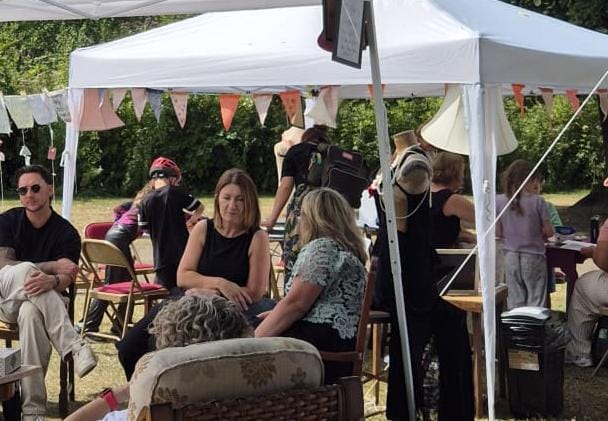
The Talking Shop Blackwood and The Talking Shop on Tour
With Cardiff Capital Region
May 2025 / 28 July – 1 August 2025
“I came here because I am interested in democracy and there is nowhere else to go.” – Talking Shop on Tour visitor Newport July 2025
General Awareness and Understanding 33
When and where did this work take place? 35
What do Talking Shop visitors talk about? 39
What creative sessions were programmed? 49
How comfortable did visitors feel in sharing their views and opinions? 60
Key Themes from General Public Responses on Equality Plans 61
What actions would you like to see to improve equality and inclusion? 83
What is your experience of equality of inequality in the Cardiff Capital Region? 107
Summary of Specific Examples of lived experiences 108
Equality Plan Information broken down into five sections 136
The Democracy Box©, The Talking Shop© and all associated content, images and prototypes are Copyright © 2020 Yvonne Murphy/Omidaze (Oh My Days!) Productions Ltd. All rights reserved. Any quotes or reuse must be accurate and must not be in a misleading context. The material must be accredited and acknowledged as Omidaze copyright
Contact Yvonne Murphy omidaze@outlook.com www.omidaze.co.uk
Oh My Days! A colloquial expression of amazement and disbelief originating in schools at the turn of the last century.
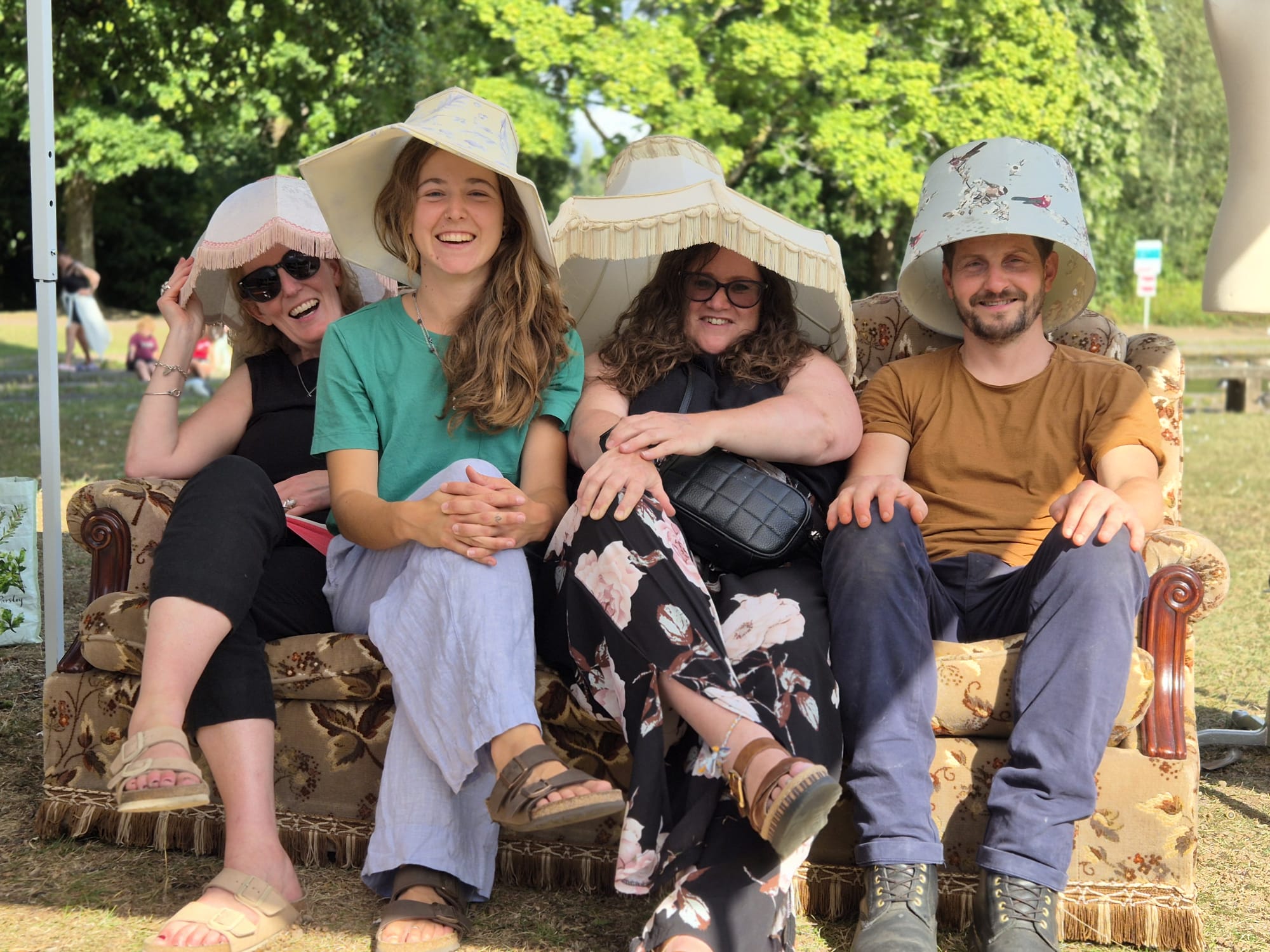
Executive Summary
Democratic disengagement, dissatisfaction and distrust of public services, public bodies and elected representatives are at a record high. Consultation fatigue is prevalent across Wales and the UK as evidenced by The Democracy Box research.
The conversations captured through this work show that while Cardiff Capital
Region’s ambition to create a more inclusive, connected, and equitable region is clear, there is still some distance to travel before that ambition is fully felt and understood by the public. Awareness of CCR, its role, and its equality obligations remains strikingly low, and across all six locations we heard repeated feelings of being overlooked, forgotten, or excluded. At the same time, the depth of engagement within The Talking Shop demonstrates both the public’s appetite and the untapped potential for involvement when people are given a genuine voice.
The majority of visitors we spoke with in The Talking Shop Blackwood and on tour had never heard of Cardiff Capital Region, had no idea what CCR does and had never heard of or seen an equality plan.
The majority were not aware that all public authorities in the UK and public bodies in Wales are legally required to have a Strategic Equality Plan or that these plans must be developed and updated every four years.
The vast majority of visitors were proactive in engaging in, and usually instigating, very open and honest conversations. A desire to be involved and heard was a recurring theme along with a curiosity about The Talking Shop itself, our vision, mission and values and the work of Cardiff Capital Region.
Distinct differences were observed between each location we visited. Blackwood was an established and fixed site and we had a balance of regular and new visitors every day. The recurring theme of Blackwood being ‘forgotten’, receiving little or no investment and playing ‘second fiddle’ to Caerphilly and Caerphilly and Cardiff receiving the ‘lions share’ of investment, projects, business, activities etc. remained a main theme when discussing Cardiff Capital Region and Equality Plans.
On tour the conversations in Newport focused primarily on immigration, public services, democratic engagement and participation, the local economy, town planning, barriers to involvement and the past, present and future of the city, Wales and the UK.
Newport had the second highest footfall and number of recorded visitors however it has the highest number of adult visitors and number of visitors staying for long periods and engaging in long in-depth and wide-ranging conversations. This high level of engagement and public discourse was charged with a positivity and sense of optimism despite the fact that Newport visitors described their city in the most negative terms out of all five locations. This negativity which was combined with a pride and sadness for what they felt had been lost and allowed to decline. This ranged from buildings to public services and community spirit and behaviour to increased crime levels.
Situated in the very centre of Newport we witnessed alcohol and drug intake and related behaviour and high levels of poverty and addiction. It is important to note however that there was no anti-social behaviour and that we felt safe and welcome and that the concept of The Talking Shop was received extremely positively, with a large majority of visitors expressing a need and desire for The Talking Shop model to be permanent and long-term.
The latter was a recurring theme across all 6 locations.
Merthyr Tydfil and Newport had the most in common in terms of a sense of sadness, nostalgia and loss of what these places had once been being present throughout our conversations along with poverty and substance misuse and addiction themes.
In Merthyr however, unlike Newport, we were located away from the town centre and therefore didn’t benefit from the natural footfall of the main shopping area. The conversations in Merthyr focused primarily on covid, mental health, cultural provision, immigration, the local economy, jobs, place making and addiction.
Conversations about Covid were most prevalent in Merthyr Tydfil and Porthcawl.
Several visitors in Porthcawl commented on having had ‘nothing like this’ since before Covid and expressed a need and a want for more cultural and creative activities and a sense of having been forgotten.
The conversations in Porthcawl focused primarily on housing, tourism, public involvement, and cultural provision.
In Porthcawl we talked to people who were from the town but had moved away due to the cost of housing and to others who still lived there who expressed regret at not having been more proactive in getting involved in conversations previously about their town. Many we spoke to were visitors from outside of town who were on holiday and spoke extremely positively about the town and surrounding area despite the horrendous weather on the day we visited.
Cwmbran, both when we visited to do promotional publicity work and on the day of the tour, was the most vibrant and upbeat of all the locations we visited. Both in the town and in the boating lake park the majority of people expressed positivity about the town and their surrounding area. The conversations in Cwmbran focused primarily on public services, provision for the young and the elderly and access to healthcare.
In Cardiff we welcomed a very diverse range of visitors as would be expected in the capital city. After Newport this was the second tour location where the majority of visitors were of adult age and where visitors stayed for the longest periods of time. The conversations in Cardiff focused primarily on access, inclusion, equality and transport.
All hosts both inside shop in Blackwood and on tour noticed a significant increase in anti-immigration rhetoric. Some of this was captured and has been detailed below in the ‘Responses’ sections to highlight what we are hearing inside the shop. It should be noted however that the hosts are trained to enable everyone to feel heard whilst simultaneously challenging all forms of discrimination and reminding all visitors of the
UK’s Equality Act and the responsibilities that accompany freedom of speech.
Any language or views which discriminate in any way are strongly challenged in the shop and facts and figures are shared to dispel misinformation. We passionately believe that The Talking Shop is needed more than ever to tackle misinformation, polarisation and the rise of discrimination.
Capturing people’s lived experiences is vital if public bodies are to ‘think more about the long-term and work better with people, communities and each other’ in order to
‘look to prevent problems and take a more joined-up approach’ as they are legallybinded to do by the Well-being of Future Generations Act.
The Talking Shop model is a new way of working which can support them to do this and put involvement at the very core of their work.
The Talking Shop model can support public bodies to develop Marmot Places and embed the Marmot Principles by
“Involving communities in the identification of the drivers of poor health and in the design and implementation of actions to reduce them.”
In conclusion The Talking Shop has shown that when people are invited into genuine, ongoing conversations, they not only engage but can help shape better, fairer decisions. Cardiff Capital Region now has the opportunity to lead the way by embedding The Talking Shop model at the heart of its involvement work and its policy and decision making and in doing so live its value of inclusivity, ‘ensuring everyone feels seen and heard’ and ‘nurturing an inclusive economy where no one gets left behind. Investing in and embedding The Talking Shop model will support Cardiff Capital Region to meet its priorities around supporting the creative economy and matching economic ambition with progressive social policies which have been developed with the public which CCR has been created to serve.
The lack of awareness we encountered highlights both the scale of the challenge and the scale of the opportunity. What is striking, however, is the depth of willingness among people to engage when given the chance, and the clear appetite for approaches that make them feel heard and valued. By embedding models such as The Talking Shop at the heart of its involvement work, CCR has the chance not only to close the gap between vision and reality, but also to set a new standard for genuine public participation in Wales — one that can build trust, strengthen communities, and turn ambition into tangible impact.
“That’s why this shop is here though…to air stuff….we’re venting because no one is listening to us.” – Talking Shop visitor Blackwood May 2025
Key Highlights
Visitors’ top priorities for improving equality in the region
- 1st priority: Affordable Housing
- 2nd priority: Accessible and inclusive transport
- 3rd priority: Employment opportunities for underrepresented groups
“Employment opportunities and upskilling opportunities are connected. You need the opportunities to develop the tools and skills you need for the life you need and to get the job you want.”
Visitor Numbers’
The Talking Shop Blackwood – During the month of May 2025 we recorded 763 visitors with the average daily footfall being 31 and the highest daily footfall being 46
The Talking Shop on Tour Week –We recorded 311 visitors across 5 locations in the Cardiff Capital Region
Equality Plans – Key themes and responses
1. Low Awareness and Understanding
- Most people were unfamiliar with equality plans and surprised that the public could be involved.
- Many people had never heard of an equality plan before.
- Lack of knowledge about what an equality plan is, why it exists, or how the public can be involved.
- Confusion around why CCR (Cardiff Capital Region) needs its own plan when local authorities already have theirs.
2. Accessibility and Communication Issues
- Information is hard to find or understand.
- Equality plans are seen as overly complex, full of jargon, “corporate speak,” or written for specialists rather than the public.
- Calls for simpler, clearer language and better explanation of purpose and impact.
- Need for creative and accessible ways to share information (beyond just online).
- Suggestion that awareness could start earlier, e.g., being taught in schools
3. Transparency and Accountability Concerns
- Questions about funding: where the money comes from and what changes are actually happening.
- Unclear why equality plans have to be renewed every four years.
- Doubts about whether multiple separate plans (CCR vs. local authorities) are necessary.
Sample responses
- I didn’t know the public could be involved in one What is an equality plan anyway?
- Never heard of one
- I didn’t know what one was
- I didn’t know what it was
- It’s difficult to find information or understand it
- If all local authorities have their own equality plan what does CCR need its own one?
- Why don’t all local authorities have one equality plan that they just add their own specific detail to?
- What’s changed? Where’s the money come from the shape this policy?
- Why does it have to happen every four years?
Sample responses to ‘What are your thoughts on Cardiff Capital Regions Equality Objectives?’
- Vague, abstract, corporate speak
- Too much information. It needs to be broken down.
- Make it simpler!
- Very complicated wording
- It’s written for someone who’s got a degree
- The language and terminology used is gibberish
- The words that are used are vague
- Say what you mean for public involvement
- Meaningless
- Why don’t all local authorities and Cardiff Capital Region all use the same equality plan?
- Why do they have to redo it every 4 years?
“I didn’t understand the question- what do you mean by equality and inequality?”
Summary of Main Themes
Responses to the question about how people from different backgrounds are treated in the region tended to highlight a mix of positive and negative experiences — with genuine progress in diversity and inclusion, but ongoing concerns about discrimination, unequal treatment, and the gap between policy and lived reality.
“As an immigrant things are very difficult at the moment.”
The main themes emerging from responses captured around inequality or discrimination personally experienced or witnessed with public services highlighted persistent barriers in accessibility for disabled people, age-related inequalities, and language/accent discrimination, alongside frustrations with declining public transport services.
“I had to wait 35 minutes to use the disabled bathroom (at bus station) because it was padlocked shut.”
These issues are compounded by a wider sense of social fragmentation and weakened community support, leaving people feeling more vulnerable and less valued in their daily interactions with public services.
“What are public services? -People don’t know what comes under the bracket of public services”
Regarding how inclusive public services are responses suggest that regional public services are not fully inclusive across disability, race, gender, religion, or sexual orientation. Key barriers include poor accessibility (especially transport), ageism and digital exclusion, lack of understanding of neurodiversity and mental health, and language/cultural discrimination.
“Last minute cancellations that happen regularly. Often cannot get home for hours. Reluctant to come to town as I can’t trust bus services.”
To improve equality and inclusion overall people would like to see more accessible public services, transport, and spaces that meet diverse needs, fairer access to employment, housing, health, and social support and transparent governance that genuinely involves communities in shaping policies.
People also highlighted broader issues of declining community spaces, lack of trust in public bodies, and unequal distribution of resources. At the same time, examples like The Talking Shop and youth participation forums were highlighted as examples of genuine, informal, and face-to-face engagement which can build inclusion and restore confidence.
“Public services (in the region) are not inclusive for neurodiversity. Lack of understanding and empathy.”
Responses highlight that disadvantaged and marginalised people face barriers including poor access to information, bureaucratic consultations, economic inequality, limited local services and transport, digital exclusion, social prejudice, inconsistent public services, health or disability challenges, language and immigration obstacles, and declining youth opportunities.
“People are afraid to approach their local authorities.”
Good examples of people’s voices being heard in regional decision-making included The Talking Shop, which provides an informal, welcoming space for community input; youth advisory boards and the Youth Parliament, which allow young people to influence policies and see their contributions reflected in real decisions; and councils adopting human-rights-informed approaches, with independent panels reviewing accessibility and inclusivity. These initiatives demonstrate that active listening, coproduction, and transparent feedback can make regional decision-making more accessible, inclusive, and impactful for all communities.
When asked how public bodies can better involve communities and make sure everyone has an equal voice when making plans, decisions and policies we were told repeatedly that creating welcoming, inclusive spaces for dialogue and making involvement engaging and relevant were key.
“What a fantastic idea. (The Talking Shop) This is the answer! Relaxed, informal listening. People need to feel they are listened to. Build up their confidence again. Too many people feel they don’t count and their opinions don’t count. This feeling has led to civil unrest and strengthening far right views. Too often public consultation is a tick box exercise.”
Participants shared a range of messages with the Cardiff Capital Region (CCR), highlighting the positive impact of community initiatives like The Talking Shop and calling for more support for young people, cultural activities, and local economic regeneration. They raised questions about CCR’s role in transport compared to Transport for Wales and asked for clearer communication. Many emphasised the need for better signage, promotion of regional “hidden gems,” and investment in green spaces and infrastructure, particularly in areas like Porthcawl. Discussions also reflected concerns about economic decline, low wages, and funding priorities, with participants wanting greater public involvement in spending decisions and more emphasis on revenue funding to sustain community-led change.
“Everything feels so hidden! People don’t know that any of this is going on. Give the opportunity, permission and voice.”
Summary of key Messages
- Accessibility and Disability Inclusion
“Disabled people need better access to be able to use public services.”
- Disabled people reported barriers in using public services, particularly public transport (locked disabled toilets, lack of ramps, unreliable or inaccessible buses).
- Inclusion in terms of disability is described as an “afterthought”, with insufficient planning or investment in accessible infrastructure.
- Calls for better training of staff to understand how to make services inclusive.
- Digital Exclusion and Over-Reliance on Technology were expressed with concerns about services shifting to apps and online platforms, excluding older people, disabled people, and those without digital access.
- Desire for face-to-face services and paper-based options to remain available.
- Difficulty accessing disabled facilities
- Disabled people cited experiences of often being ignored or spoken over in public interactions, undermining dignity.
- Call for all public services and buildings to be more inclusive and accessible to everyone and to develop human-rights-based approaches to service provision to ensure equality in access and experience.
● Strong perception of a lack of understanding, empathy, and provision for neurodivergent people in wider public services
- Transport as a Key Barrier
- Public transport, especially buses, seen as unreliable, inaccessible, and discriminatory towards disabled and older passengers.
- Reports of aggressive or rude treatment by drivers and a lack of accountability.
- Limited routes and cuts to services mean people cannot access hospitals, schools, or jobs without cars, creating systemic inequality.
Frequent bus cancellations and service cuts, disproportionately affecting vulnerable users (older people, those with health conditions).
- Discriminatory, prejudiced, aggressive or rude behaviour from bus drivers, with passengers feeling disrespected.
- Incidents of poor treatment of passengers (e.g., older woman forced off bus).
- Expand public transport coverage and frequency, ensuring consistent access to cities, towns, hospitals, and essential services.
- Ensure all buses and transport facilities are fully accessible, including wheelchair spaces and functioning disabled toilets.
- Train transport staff to support passengers of all abilities, including those with disabilities, older adults, and neurodiverse individuals.
- Provide affordable, user-friendly ticketing options and clear guidance on transport services.
- Public transport not consistently accessible for wheelchair users or people with mobility issues.
“Not inclusive for the older generation or for the disabled. Public toilets shut and cut to bus services and places locally where people need to go. People with cars travel away from Blackwood to access educational classes and entertainment. Even access to the regional main hospital requires the use of a car!”
- Welsh Language
- Discrimination experienced by those with foreign accents or whose first language isn’t English, with inadequate support to learn English or Welsh.
- Concerns about Welsh language provision, and not always able to access bilingual services.
- Provide bilingual services and signage (Welsh and English) across public services.
- Offer support for learning Welsh and English for immigrants and refugees.
- Celebrate cultural and religious diversity, ensuring that people of all faiths and backgrounds feel respected and included.
- Trust, Voice, and Civic Participation
“Please continue to encourage people to give their views. At the moment too many people in the UK believe they (& their views) do not count. Listening is important and so is giving people confidence that they are listened to.”
- Many people feel their voices are not listened to in consultations or decision-making (“tick-box exercises”).
- Lack of clear communication from councils and services fuels mistrust and disengagement. A lack of transparency and responsiveness in local decision-making reduces confidence that voices will be heard.
Examples from elsewhere (e.g., York’s human rights approach) and youth forums show what inclusive participation, public engagement and involvement could look like.
- Develop more community hubs, green spaces, cultural venues and public spaces accessible to all ages and abilities
- Ensure these spaces support creativity, learning, and social connection for the whole community.
- Encourage informal, welcoming consultation and engagement spaces to enable people to influence local decisions.
- Promote safe, welcoming communities with visible policing and youth engagement programmes
- Encourage initiatives that strengthen intergenerational and intercultural relationships.
- Foster respect and inclusion across diverse social and cultural groups.
- Create accessible, jargon-free opportunities for people to participate in decision-making and equality plans. Complexity of language and terminology in public documents, policies, and equality plans makes it difficult to understand rights and opportunities.
- Involve diverse community representatives in consultations, coproduction, and policy development.
- Provide support such as travel costs or time compensation to encourage participation from young people and marginalized groups.
Citizens are frequently unaware that they can participate in consultations, forums, or decision-making processes.
- Formal consultations are seen as uninviting, bureaucratic, or irrelevant, deterring participation.
- Limited opportunities for youth, minority groups, and people with disabilities to engage meaningfully and be compensated for participation (e.g., travel, time).
- Economic and Structural Inequalities
- Complaints about uneven distribution of wealth and funding across the region, with rural/Valleys areas feeling left behind.
- Perceptions that services favour certain groups (e.g., “non-British immigrants,” “the rich”), creating resentment and a sense of unfairness.
- Housing, jobs, and cost of living pressures repeatedly linked to exclusion from services and opportunities.
- Call for fair access to employment, skills training, and apprenticeships, particularly in areas with fewer opportunities.
- Experiences of Inequality and Discrimination.
- Reports of people from minority or marginalised groups facing prejudice, stereotyping, or unequal treatment in the region and often lack clear information about available services, opportunities, and equality policies.
Specific issues raised around race, disability, gender, or socioeconomic background.
- Non-native English speakers treated rudely or dismissed due to their accent.
- Experiences of sexism, racism, and xenophobia reported.
- Strong feelings around immigration, with some blaming migrants for reduced access to services, while others call out prejudice and rightwing narratives as divisive.
- Reports of being judged by appearance or first impressions, leading to exclusion
- Treatment differs depending on where someone lives, their background, or the services they are accessing (e.g., education, healthcare, housing).
- Some areas or groups may feel more included than others.
- Barriers to employment, services, and public life for people from different backgrounds.
- Perceptions of unequal access to opportunities or resources
- Some respondents highlight progress in inclusivity and celebrate multiculturalism. A general sense that communities are generally welcoming, even if challenges remain.
“Prejudice against people from different cultures and ethnicity”
- Gaps Between Policy and Reality
- Recognition that equality policies exist, but people feel their day-to-day experiences don’t always reflect these commitments.
- Frustration with “tick-box” approaches that don’t lead to meaningful change.
- Need for Greater Awareness and Education
- Calls for more understanding of different cultures, religions, and identities to reduce prejudice.
- Desire for public institutions to lead by example in creating inclusive spaces.
- Need to promote education and awareness campaigns to challenge stereotypes and reduce bias and encourage respectful dialogue and understanding between different communities.
- Increase training for public service staff on inclusivity, accessibility, and cultural awareness.
- Age-Based Inequalities
- Older people feel neglected by services (particularly public transport).
- Technology creating barriers for older generations, making life harder rather than easier.
- Experiences of ageism in everyday interactions (e.g., bus incidents, being treated as if their voices/opinions don’t matter).
- Concerns about how young people are portrayed (stereotyped as troublemakers), contributing to intergenerational tensions.
- Need for greater inter-generational interaction and calls to create spaces and opportunities for young and older people to interact, learn from each other, and share skills.
- Expand youth provision, including clubs, creative spaces, and recreational activities, to support engagement and development
- Youth have fewer structured opportunities to participate in forums or decision-making processes.
- Past closures of youth clubs and structured social spaces reduce skills development and social cohesion, increasing anti-social behaviour.
- Young people often lack confidence, knowledge, or practical support (e.g., travel, payment) to access civic and educational opportunities.
“I’m worried about the older generation who feel too scared to come into town.” (Newport resident)
- Digital and Technological Inclusion
- Maintain accessible offline options alongside digital services to ensure inclusivity.
- Provide support for digital literacy for people of all ages and abilities.
- Implement responsible regulation of new technologies to protect vulnerable users.
- Maintain offline services alongside digital options to ensure all generations can access essential services.
13. Policy and Governance
- Calls to standardize equality plans across local authorities while allowing for local context.
- Calls to increase transparency about funding, policy decisions, and outcomes of equality initiatives.
- Calls to ntroduce independent scrutiny to ensure policies meet human-rights and inclusivity standards.
- Community and Social Infrastructure
- Widespread sense of declining community spaces (libraries, youth clubs, community centres), leading to isolation and reduced intergenerational connection.
- Calls for more local cultural, social, and green spaces accessible to everyone.
- The Talking Shop itself was seen as a model of inclusive consultation, in contrast to formal, inaccessible public engagement processes.
- Good examples of people’s voices being heard in regional decision-making
- The Talking Shop – praised repeatedly as a relaxed, informal space where people feel listened to, can share their views, and build confidence.
- The Talking Shop on Tour bilingual signage – engaged people in discussions, encouraged interest in Welsh language learning, and showed how inclusive communication can foster participation.
- Children’s Commissioner for Wales Youth Advisory Board – provided an example of youth contributing to policies, seeing them implemented, and gaining access to other civic opportunities, including representing young people on the Town Council.
- Youth Parliament and lowering the voting age – highlighted as a way for young people to be heard, influence decision-making, and engage in governance, though noting improvements are needed (e.g., ensuring representation and providing support for travel/time).
- York’s human rights approach – council support for historical building accessibility, public scrutiny via independent panels including members of the public, demonstrates a human rights-informed decision-making process.
- Opening bus station toilets at Blackwood Bus Station – reflects responsive action to public feedback.
- Encouragement for inclusive participation in civic life – respondents noted that initiatives that actively listen, build confidence, and allow people to feel their opinions matter (e.g., co-production, accessible information) are positive examples.
- Community hubs and local spaces – highlighted as important venues where people can meet, access services, and participate in activities that respond to community voices.
- Accessibility improvements and bilingual services –incorporating public feedback which led to practical, inclusive outcomes.
- Advocacy on transport and public services – examples where individuals or groups raised issues (like bus accessibility or public toilet access) and saw recognition or action.
“It’s all around us-on the Blackwood High Street with the businesses. Lack of employment, lack of opportunities and lack of people in the area.”
How can public bodies better involve communities and make sure everyone has an equal voice when making plans, decisions and policies?
Summary of responses
1, Create welcoming, inclusive spaces for dialogue and making involvement engaging and relevant
- Move away from formal, dry, or tick-box exercises.
- Use bilingual or culturally appropriate signage and materials to signal inclusivity and engagement.
- Ensure events feel directly relevant to the community, connecting to local issues people care about.
- Provide opportunities to ask questions and get meaningful answers, not just listen to presentations.
2 Prioritize visibility and accessibility
- Keep consultation locations and services easy to find and physically accessible (ramps, parking, toilets, clear signage).
- Use local hubs, libraries, and community centres as accessible points for engagement.
- Offer non-digital options for participation, such as paper forms, face-to-face meetings, and phone consultations.
3. Address systemic inequalities
- Identify and address structural barriers e,g transport that prevent participation.
- Ensure services are inclusive of older adults, disabled people, neurodiverse individuals, and minority communities.
- Integrate considerations of age, disability, language, and gender into planning processes to reduce exclusion.
4. Build trust through transparency and accountability
- Show how community feedback leads to change; avoid letting input disappear without acknowledgment.
- Provide clear information on policy processes, funding, and decision timelines.
- Explain why decisions are made and how public voices were considered, especially in controversial or high-impact projects.
5. Support active participation
- Provide resources to enable involvement, such as travel reimbursement, childcare, and support for those with disabilities.
- Encourage community representation on panels, committees, and boards to reflect the diversity of the population.
- Offer training or guidance to help people understand how to engage and influence policies effectively.
6. Promote intergenerational and cross-community dialogue
- Create opportunities for young and older people to learn from each other, helping voices across age groups to be heard.
- Develop community events that mix different cultural, linguistic, and social backgrounds to encourage mutual understanding.
7. Monitor and adapt engagement approaches
- Evaluate what works and what doesn’t in community engagement, using feedback from participants.
- Adapt methods to better reach underrepresented groups, including those with limited tech access.
- Make engagement ongoing, not one-off, to maintain connection and trust over time.
8. Highlight tangible outcomes, local success stories and opportunities
- Publicize changes that result from community input to demonstrate impact.
- Share clear information on policy outcomes, improvements, or local services that have been influenced by public feedback.
- Share best practice examples like youth advisory boards, human-rights-informed councils, and The Talking Shop, showing people that their voices can have real impact.
- Publicize small wins, such as reopening public toilets, to encourage broader participation.
The Talking Shop and The Talking Shop on Tour revealed the everyday barriers people across the Cardiff Capital Region face in accessing public services, from unreliable transport to the loss of community spaces and the lack of inclusive design in services. These experiences show that equality and inclusion must be embedded throughout how public services are planned and delivered, not treated as one-off consultations. The CCR’s Strategic Equality Plan (2024–2028) offers a chance to change this approach by fostering continuous, meaningful engagement that gives communities a real voice in shaping decisions.
Conversations across the Cardiff Capital Region (CCR) showed that while there is a clear ambition to create a fairer and more inclusive region, awareness of CCR’s role, responsibilities, and equality commitments remains low. Many participants expressed feelings of being overlooked or forgotten, particularly in communities facing economic challenges, limited public services, or declining infrastructure. Despite this, there was a strong appetite for meaningful engagement and a clear desire from residents to contribute to shaping the future of their places.
These findings highlight both the challenge and the opportunity for CCR to strengthen trust, improve communication, and embed public involvement at every stage of planning and policy-making. By creating consistent, accessible, and inclusive opportunities for dialogue, CCR can ensure its work reflects the lived experiences and priorities of the people it serves. This approach would help close the gap between regional ambition and everyday reality, supporting more responsive, equitable, and sustainable decision-making across the region.
General Awareness and Understanding
General awareness of Cardiff Capital Region and awareness and understanding of equality plans and public bodies’ legal duty was extremely low with the vast majority of visitors in all locations having never heard of either.
A short one to two sentence summary of what Cardiff Capital Region is and does would have been extremely useful along with a brief mission statement.
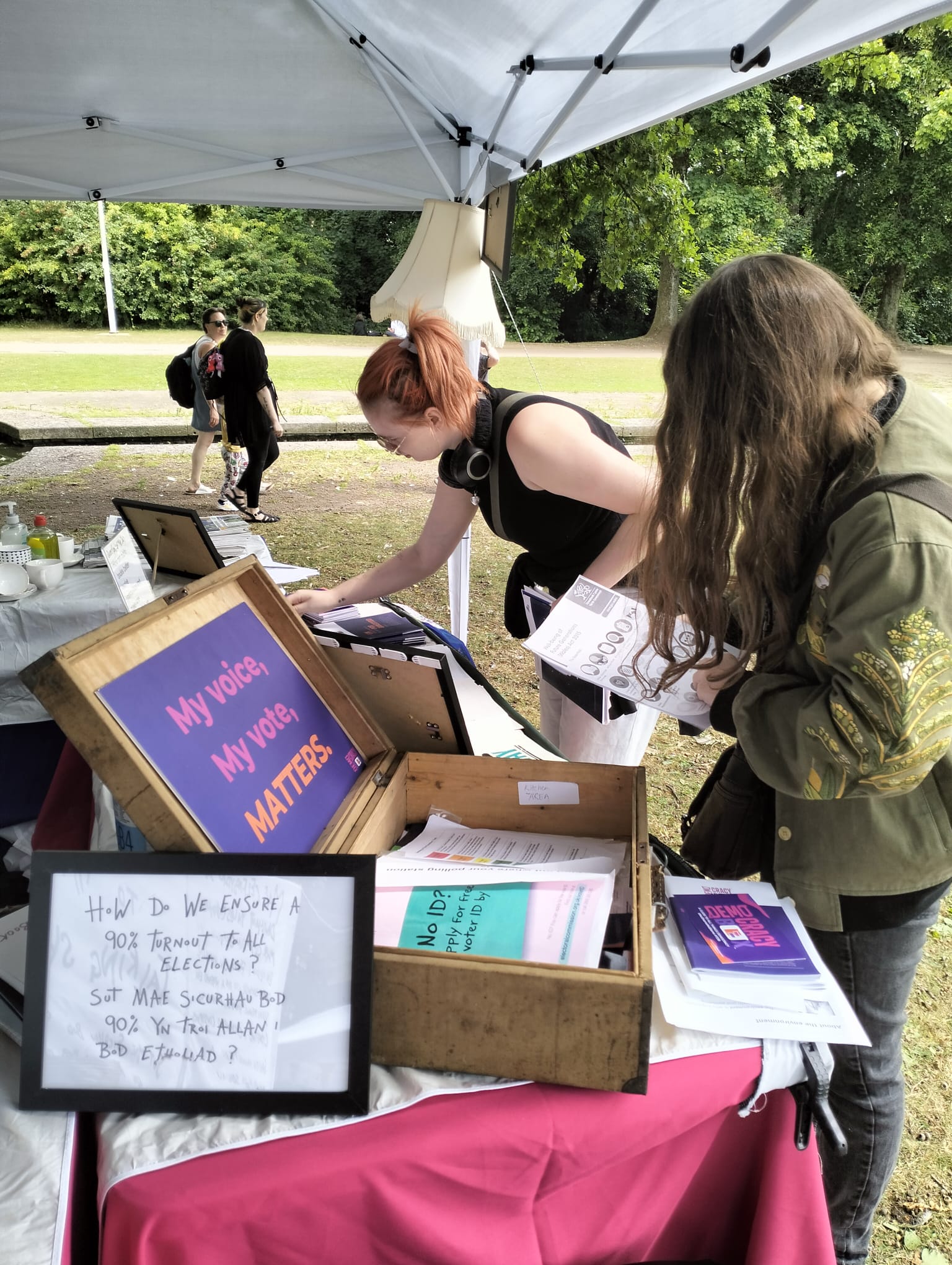
We had anticipated that awareness and knowledge would be low based on a wealth of previous conversations inside The Talking Shop in various trial locations. We therefore dedicated a table to information in both the Blackwood shop and whilst on tour. We separated the information into five bitesize chunks as outlined in appendix 3. Responses (verbal and written) primarily expressed frustration at a perceived lack of communication and involvement with the public leading to a general lack of awareness and understanding. The language used in both the questions, related literature and the policy itself was a major concern for the majority of visitors with the language being described as ‘corporate’ and too difficult to understand by many and being cited as a barrier to involvement.
When and where did this work take place?
The Talking Shop Blackwood hosted Cardiff Capital Region and a conversation around Equality Plans inside the Blackwood Talking Shop throughout the month of May 2025. We then toured across the Cardiff Capital Region during one week in the summer of 2025 to the following five locations working collaboratively with each local authority.
| CARDIFF | Mon 28
July |
| PORTHCAWL |
Tues 29 July |
| CWMBRAN | Wed 30
July |
| NEWPORT |
Thurs 31 July |
| MERTHYR TYDFIL | Fri 1
August |

What is The Talking Shop?
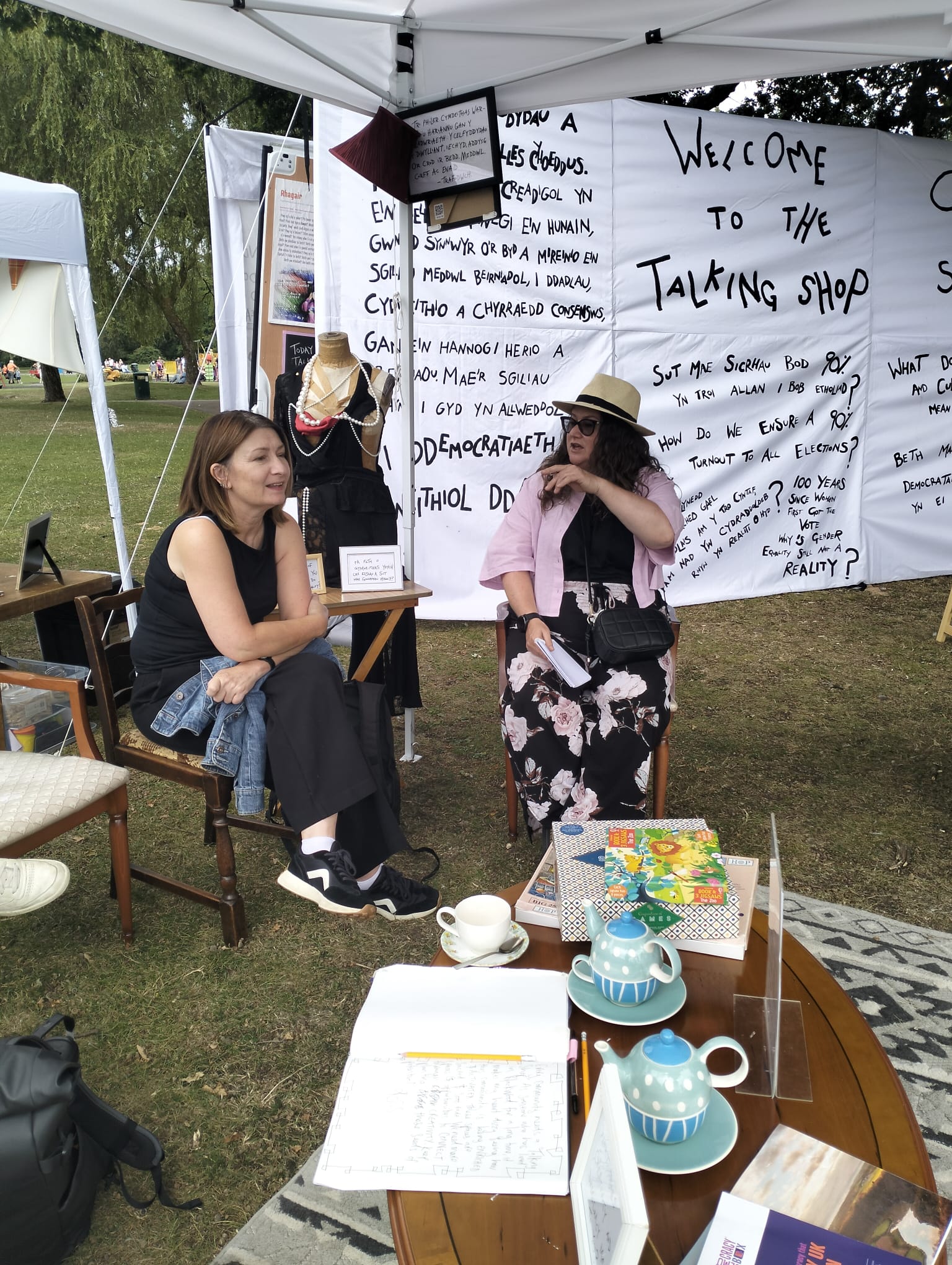
The Talking Shop is a cultural and democratic information centre. A public space created and facilitated by artists. The Talking Shop mission is to increase cultural and democratic participation through conversation, information and democratic deliberation using creativity and creative practices.
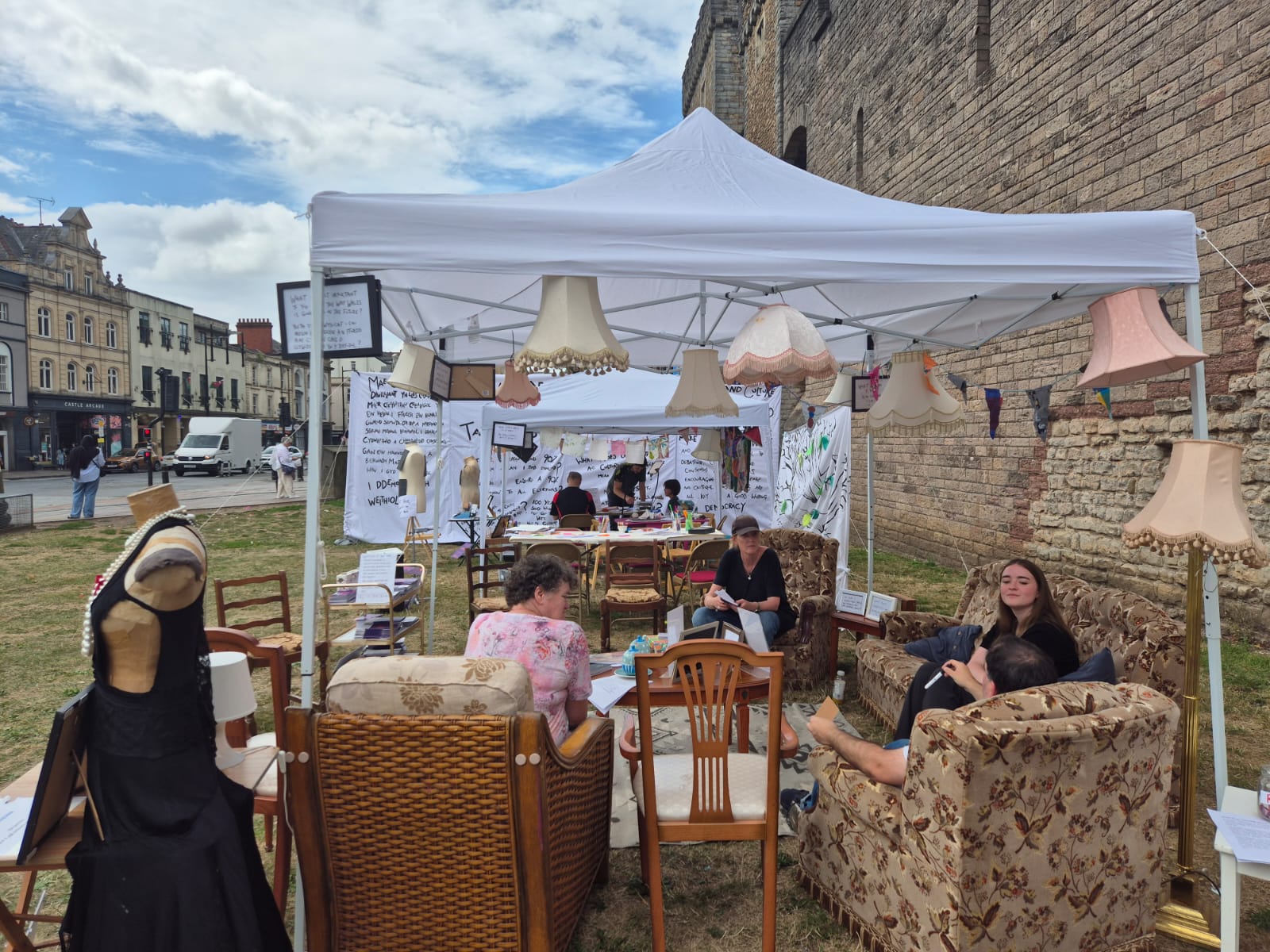
Inside The Talking Shop everyone is welcome. There is no need to book. Visitors just pop in and stay as long as they like. Free Wi-Fi. Free tea. Free information and conversation. Visitors of all ages and from all backgrounds and social and economic demographics join in a conversation or programmed activity or work, study, read, draw, think, meet people or just find a quiet place to just ‘be’.
Trained hosts begin open conversations around democratic and cultural engagement. Hosts introduce the public to The Democracy Box and Omidaze’s The story of our UK democracy© and signpost visitors to democratic and cultural information.
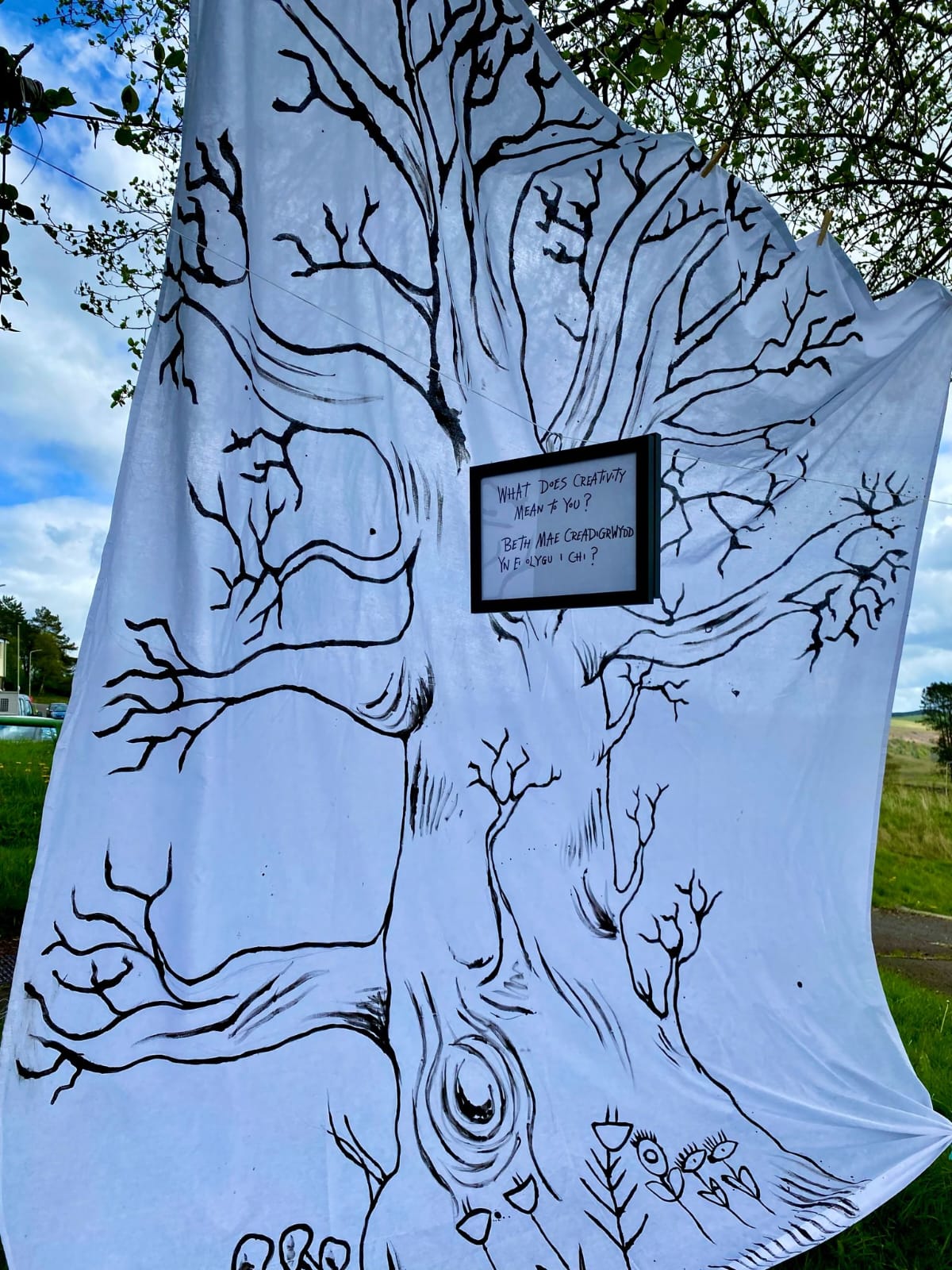
On The Talking Shop walls are big open questions which are used to centre and focus conversations between complete strangers who enter and meet over a cuppa.
Everyone contributes to and helps curate the shop. The Talking Shop aims to address the current democratic deficit by raising democratic participation (including but not limited to registering to vote) through conversation, information and creative approaches to democratic deliberation.
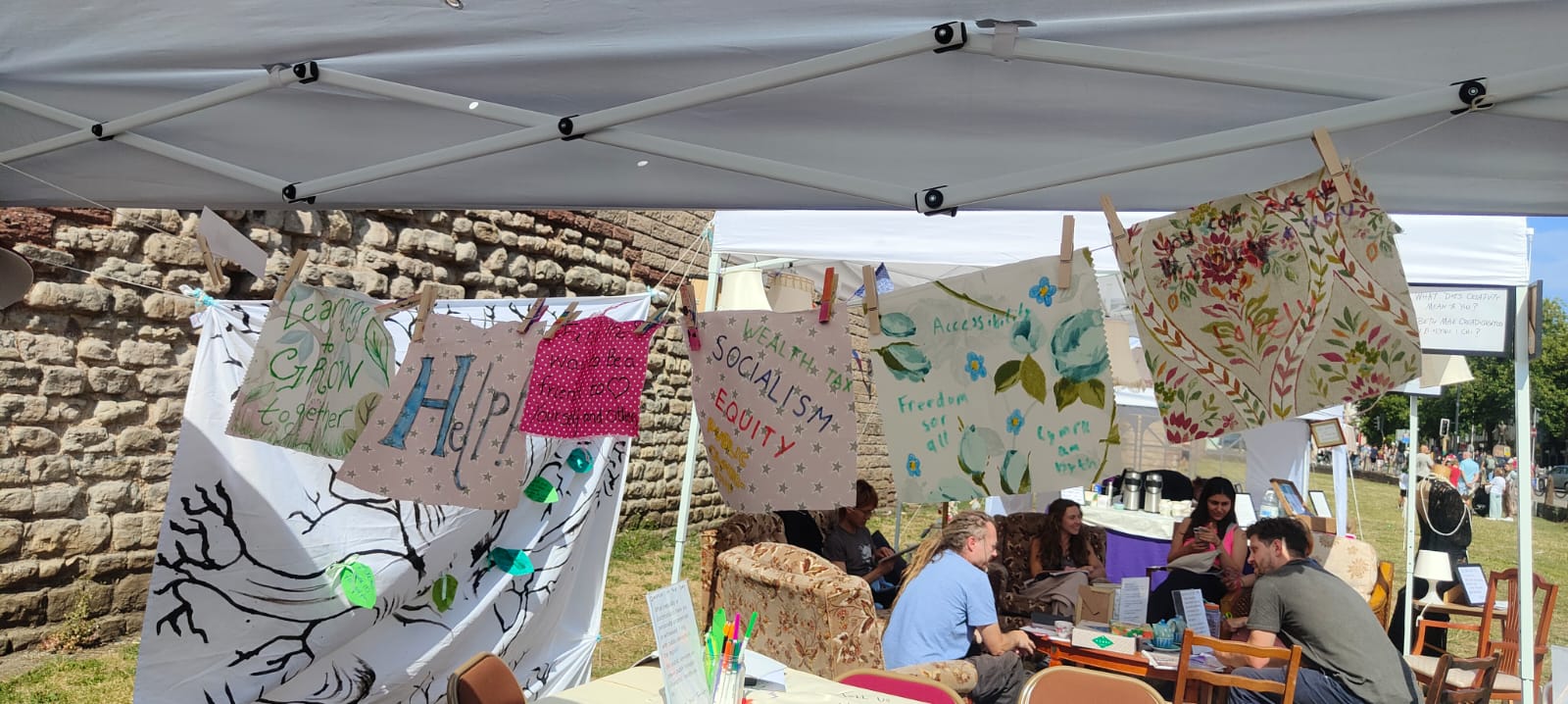
The Talking Shop’s creative approaches to deliberative democracy have included bunting making, collaging (individual and collective), stone painting, poetry, journaling, origami, knitting, crocheting, music, podcasting, creative writing, paper lantern making, graffiti, Christmas crafts, clay modelling, pompom making, illustration, zine making, dance and spoken word.
Everything inside The Talking Shop is being carefully designed and created in response to years of research and thousands of visitors and their feedback.
The Talking Shop has a zero or minimal carbon footprint. All furniture and shop dressing is begged, borrowed, gifted and recycled.
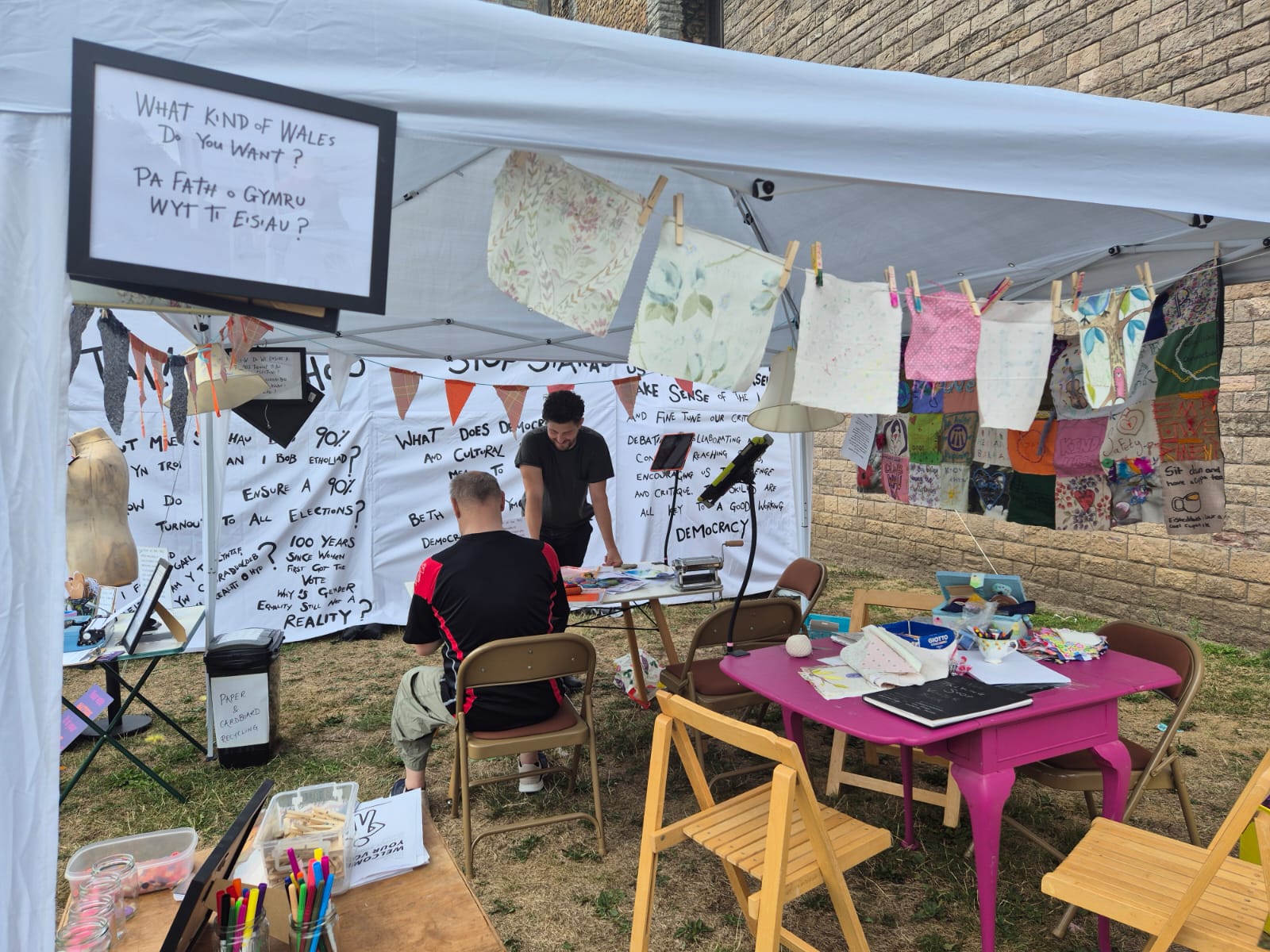
The Talking Shop on Tour is an outdoor mobile version of The Talking Shop which is home to The Democracy Box and can arrive on a beach, a housing estate, a village green, park or public patch of grass and become The Talking Shop ‘without walls’ for the day. The touring version uses the same design, creative approach and main key ingredients of The Talking Shop. The Talking Shop on Tour was researched and developed in two stages in August 2024 funded by the Gwent Police and Crime Commissioner and in March/April 2025 and trialed successfully in three outdoor locations in the South Wales Valleys in April 2025 funded by Cwm Taf Morgannwg University Health Board
Imagine if we had a Talking Shop in every local authority across Wales and a touring Talking Shop without walls in the summer months. Imagine if we had ongoing conversations all year round about democracy and culture with everyone feeding into policy and decision making at all levels of government, across all departments and into all our public bodies shaping our public services together. Not through tick box consultation. Through conversation, information and democratic deliberation using creativity and facilitated by professional creatives.
“There is evidence to show that cultural participation can contribute to social relationships, community cohesion, and/or make communities feel safer and stronger. Research has found positive links between cultural participation and improved social skills and engagement with the wider community” – ‘The Culture
White Paper’, Department for Culture, Media and Sport, 2016
What do Talking Shop visitors talk about?
A question of the day helps to focus the facilitated conversations and conversation prompts and open questions decorate the shop and are integral to the design. The creative activities are also often focused around a theme or particular question. The most common themes and topics which the Talking Shop visitors bring up, in no particular order, are
- Improving confidence, self-esteem and expectations
- Rehabilitation
- Climate Emergency
- Equality
- Access
- Employment opportunities
- Skills and Training
- Volunteering
- Transport
- Housing
- Representation in decision-making
- Requests for signposting to all services
- Social and economic health of the area
- Tourism
- The High Street
- Intergenerational connection
- Democratic and cultural knowledge and participation
- Voter engagement and turn
- Consultation fatigue
- Mental and physical health and well-being
- Isolation and loneliness
- Polarisation
- Cohesive communities
- Crime and anti-social behaviour
Strategic Equality Plan Engagement – Proposed Questions/Discussion Points and Information and how we integrated these into The Talking Shop model
We used the following questions/prompts for discussion and utilised these also as part of the creative activities sessions
- How would you improve these example Equality Plans on the table?
- Before today how much did you know about Equality Plans?
- Where would you go to find information about a local government, Cardiff Capital
Region or any public body’s equality plan?
- What are your thoughts on Cardiff Capital Regions Equality Objectives?
We captured responses to all of the above via host notebooks, mind maps and a range of creative methods including
- The information table was covered in lining paper. Writing and drawing materials, post-it notes and paper
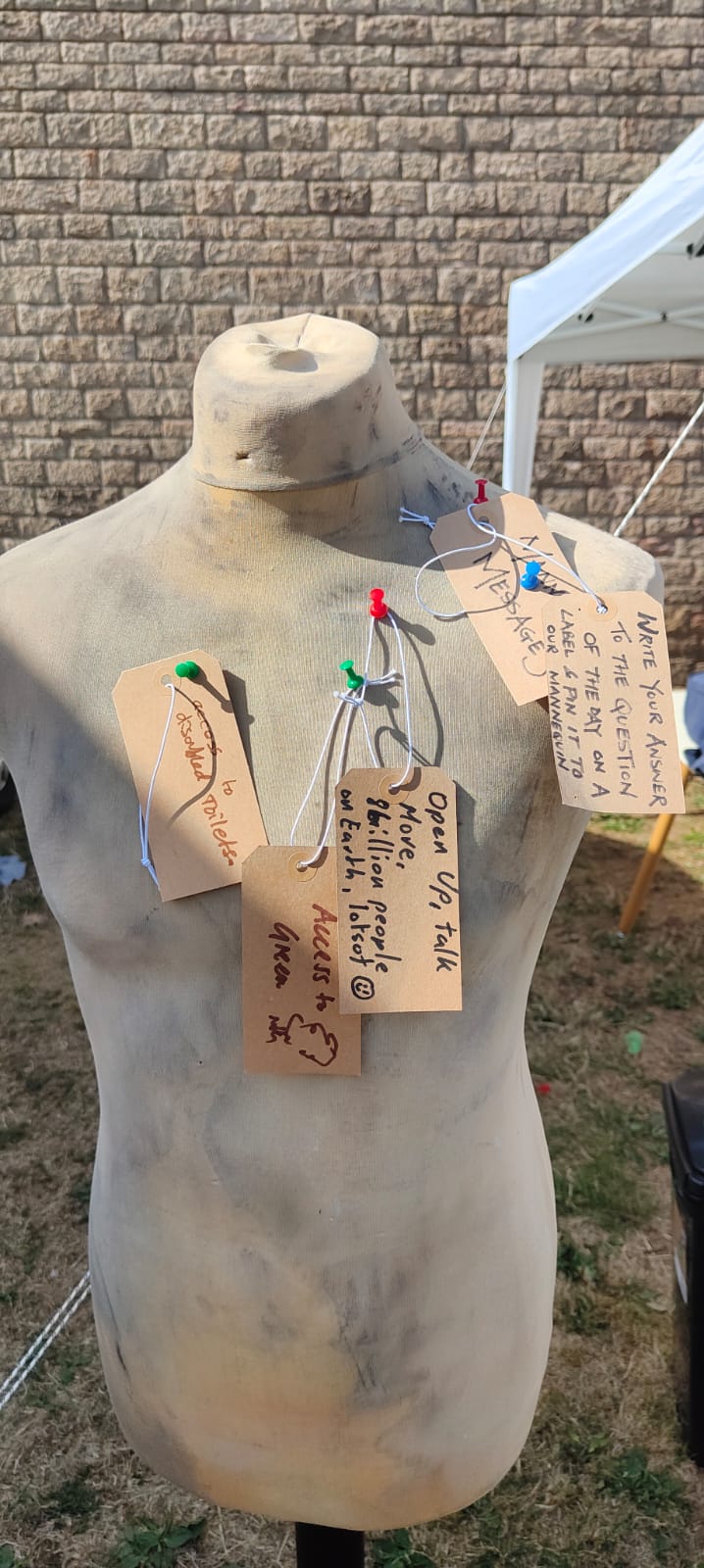
- Mannequin Messages – we used brown luggage labels for visitors to write messages and pin them to a mannequin. This was trialed on tour.
- Talking Shop Tree of Thought – this is an ongoing creative tool inside every Talking Shop which allows visitors to write on a green paper leaf and respond to the question of the day or any of the questions in the shop and pin in to our painted Tree of Thought on the shop wall
- Visitors Books – this is an ongoing data capture method within The Talking Shop. All visitors are encouraged to leave something in the visitors book in response to their visit and the question of the day
Priorities for the region
In addition to the questions above we were asked by Cardiff Capital Region to ascertain which of the following areas should be the top priorities for improving equality in the region
- Equal access to upskilling opportunities
- Employment opportunities for underrepresented groups
- Accessible and inclusive transport
- Affordable housing
- Representation in decision-making
The Talking Shop Washing Line
We designed a new bespoke interactive creative installation to capture responses which identified and differentiated the top three priorities. All visitors in Blackwood and on tour were encouraged to choose their top three priorities and display them on the washing line, putting them in order of 1st, 2nd and 3rd using a colour key for the material squares which they added. This method, together with all the creative methods proved extremely successful. Visitors were engaged and happy to discuss the priorities and found the activity fun and thought inspiring in equal measure. The washing line provoked conversation and discussion with some visitors choosing to peg together different options which they saw as inseparable i.e. equal access to upskilling opportunities and employment opportunities for underrepresented groups
Questions of the Day
Experience and Inclusion
- What are your thoughts on how people from different backgrounds are treated in the region where you live?
- What inequality or discrimination have you personally experienced or witnessed, if any, with public services in the region? (By public services we mean public transport. Education, healthcare etc.)
- How inclusive are regional public services for everyone whatever their disability, race, gender, religion, sexual orientation?
- What actions would you like to see to improve equality and inclusion?
- What are the barriers which prevent people from disadvantaged or marginalised backgrounds accessing opportunities in the region?
Engagement and Representation
- What good examples are there of people’s voices being heard in regional decisionmaking?
- How can public bodies better involve communities and make sure everyone has an equal voice when making plans, decisions and policies?
General
- What is your experience of equality of inequality in the Cardiff Capital Region?
(Cardiff Capital Region is South East Wales and includes 10 Local Authorities –
Blaenau Gwent, Bridgend, Caerphilly, Cardiff, Merthyr Tydfil, Monmouthshire, Newport, Rhondda Cynon Taf, Torfaen, and the Vale of Glamorgan)
The eight questions of the day were drafted by Cardiff Capital Region and edited and simplified by Omidaze Productions. We used these questions in Blackwood, Cardiff, Porthcawl and Cwmbran. We used them for part of the day in Newport and did not use them at all in Merthyr Tydfil.
We found that the questions were a barrier to engagement. Their length and vocabulary made them complex and difficult for many visitors to engage with. On reflection it was also felt that they went against the ethos and methodology of The Talking Shop which does not use extractive and binary consultation techniques.
We also became confident as the tour week progressed that the questions would be naturally answered through the facilitation of the hosts. All hosts had a question of the day in their notebooks as a reminder to help them to focus and reframe the conversations from time to time.
Responses to all the questions below were captured via
- Host notebooks – ongoing method. Talking Shop hosts make notes of key themes, quotes etc. during conversations
- The Talking Shop Typewriter – visitors are encouraged to type their thoughts on an old fashioned typewriter.
- Back Wall – The Talking Shop Blackwood back wall was dedicated to these questions during the whole month of May. The back wall was covered in lining paper and each Question of the day was added until all questions were displayed. Visitors were invited to add to the writing on the wall and answer the questions/respond directly.
- Visitor Books – Every visitor was encourage to respond to the question of the day or any of the themes being discussed inside the visitors books
- Talking Shop Tree of Thought – In addition to the visitor books everyone who joined us was also encouraged to write on a paper leaf to add to our tree of thought
- The Talking Shop Washing Line – an interactive art installation used to identify visitors priorities for the region
- Creative Outputs in facilitated sessions – See below for information about
creative sessions programmed.
- Mannequin Messages – visitors were invited to write a response on a luggage label and pin it to one of The Talking Shop mannequins
Creative Sessions are programmed in The Talking Shop to act as an engagement tool to bring people into the shop and also as a hook for conversations during the facilitated activity and as a creative approach to democratic deliberation.
The creative output itself from the sessions is another form of data capture with people’s thoughts, views, opinions threaded into whatever they create.
What creative sessions were programmed?
Blackwood
| Thursday 1st | Weaving Workshop |
| Friday 2nd | Colour Collage |
| Monday 12 | Glass Painting |
| Tuesday 13th | Bark Painting |
| Wednesday
14th |
Comic Book Drawings |
| Thursday 15th | Experimental Watercolor
Painting |
| Friday 16th | Card Making |
| Saturday 17th | Crochet social Group &
Creation station all day |
| Monday 19th | Mono printing Part 1 |
| Tuesday 20th | Comic Book Drawings |
| Wednesday
21st |
Mono printing Part 2 |
| Thursday
22nd |
Botanical Drawings |
| Friday 23rd | Rag Rugging |
| Saturday 24th | Crochet social Group &
Creation station all day |
| Tuesday 27th | Heidi Embroidery Workshop |
| Wednesday
28th |
Black Out Poetry |
| Thursday 29th | Nature Crafts |
During The Talking Shop on Tour week we programmed the following creative activities on all five days
- Paper Flower Making
- Print making using a pasta making machine
- Bunting making
- The Talking Shop Power Patchwork Clay Modelling
Additional general ongoing creative activities included drawing, painting, colouring and scrap material creations
Publicity and Attendance
The Blackwood site had been open March – June 2024 and re-opened in December 2024. There is no allocated budget line for marketing beyond initial postcards and posters and a very small amount of human resource allocated to publishing posts across social media.
For the tour week budget was allocated to print (posters and postcards) and to human resource to distribute these in each area and to also run a comms campaign across Omidaze and Talking Shop social media platforms.
The Talking Shop Blackwood
During the month of May 2025 we recorded visitors 763 visitors with the average daily footfall being 31 and the highest daily footfall being 46
The recorded weekly footfall breaks down as follows
| Week 1 (1 – 10 May) | 239 |
| Week 2 (12 – 17 May) | 189 |
| Week 3 (19 – 24 May) | 179 |
| Week 4 (27 – 31 May) | 156 |
| TOTAL | 763 |
We have noticed during all trials that footfall declines in the final weeks when visitors know that the shop is closing. The highest number of visitors for one week in The Talking Shop Blackwood prior to this period was 377.
The Talking Shop on Tour
Footfall was lowest in Merthyr and Porthcawl and highest in Newport and Cwmbran which we believe was down to location and weather. We recorded over 300 visitors across the 5 days.
| Cardiff | 48
|
| Porthcawl | 35
|
| Cwmbran | 116
|
| Newport | 86
|
| Merthyr Tydfil | 26
|
| Total | 311
|
Location made a huge difference during this week. The most successful site was in Cwmbran. We were pitched in the boating lake in Cwmbran between the playground and the café and footfall was naturally very high. We were not positioned adjacent to the playground and therefore people did not presume we were only offering arts activities for children and we successfully engaged all ages.
Newport City Centre was the second highest footfall and we retained visitors for long periods. It is important to note that we recorded high visitor numbers in Newport despite torrential rain for several periods during the day.
Merthyr Tydfil recorded the lowest footfall. There was little to no passing footfall where we were pitched. The town was busy on the day we visited and the sun was shining however footfall did not flow down towards the Redhouse which were pitched outside.
Porthcawl was similar to Merthyr in that we were located away from the hustle and bustle of the town centre and away from the entrance to Coney Island and the beach with no natural footfall coming to the grassed area. We were also located at the back of Aldi and away from the supermarket carpark and therefore we did not benefit from shopper footfall. Footfall increased only after we walked through Coney Island inviting people to join us. The weather also impacted footfall since it was an extremely windy and rainy day which will have negatively impacted natural footfall to Porthcawl generally.
Cardiff was an interesting location and very central however Cardiff was generally quiet and we were competing with several attractions, not least the castle itself, for visitor attention.
Conclusion re locations and visitor numbers – Public parks with high natural footfall during the summer months are an ideal location for The Talking Shop on Tour. In addition to natural footfall, parks offer ease of public toilets, access to water and shade and the opportunity to pitch in more sheltered areas.
The Newport City Centre pitch was an experiment since the Tour design requires the van disguise to be tethered and this is normally done with guy ropes pegged into the ground, A site visit with a Newport Council colleague allowed us to select a site which had both high natural footfall and enough fixed street furniture for us to tether to. This site proved extremely successful along with the Boat lake site in Cwmbran.
Part of the original vision for The Talking Shop on Tour was for it to arrive on a beach. Unfortunately because we could not get the van anywhere near the beach at Coney Island this vision could not be realised. In retrospect pitching in Bridgend City Centre, Newton Beach or Ogmore would have been much more successful.
The Talking Shop has recorded over 17,000 visits to trials in four locations in Wales and 100% positive feedback.
The Talking Shop pilot – Cardiff April 2019 1 month (550 recorded visits)
The Talking Shop Trials
Cardiff 4 months (1656 visits)
Newport 1 month 2022 (1005 visits)
Merthyr Tydfil 2022-23 5 months (5773 visits)
Blackwood 2024-25 10 months (8,600+)
How comfortable did visitors feel in sharing their views and opinions?
The Talking Shop model enables all visitors to feel comfortable in sharing their opinions and views about any themes related to democratic and cultural participation. All visitors to the shop across the month of May and at all locations on tour were invited to share their views via multiple methods. These are detailed above. The Talking Shop is not consultation. The Talking Shop prioritises information and conversation and uses creative approaches to democratic deliberation.
Freelance creatives host The Talking Shop and facilitate a programme of creative sessions. These creative sessions focused on the questions and discussion points above and the theme of Equality Plans, Equality, Inclusion and Discrimination generally and CCR and other public’s bodies role in involving the public in creating plans and policies including their Equality Plans. All visitors were invited to take part in a creative activity and/or to talk to us about the questions over a cup of tea.
“No one gets judged.” – Talking Shop visitor Blackwood May 2025
Key Themes from General Public Responses on Equality Plans
1. Low Awareness and Understanding
- Most people were unfamiliar with equality plans and surprised that the public could be involved.
- Many people had never heard of an equality plan before.
- Lack of knowledge about what an equality plan is, why it exists, or how the public can be involved.
- Confusion around why CCR (Cardiff Capital Region) needs its own plan when local authorities already have theirs.
2. Accessibility and Communication Issues
- Information is hard to find or understand.
- Equality plans are seen as overly complex, full of jargon, “corporate speak,” or written for specialists rather than the public.
- Calls for simpler, clearer language and better explanation of purpose and impact.
- Need for creative and accessible ways to share information (beyond just online).
- Suggestion that awareness could start earlier, e.g., being taught in schools.
3. Transparency and Accountability Concerns
- Questions about funding: where the money comes from and what changes are actually happening.
- Unclear why equality plans have to be renewed every four years.
- Doubts about whether multiple separate plans (CCR vs. local authorities) are necessary.
4. Civic Engagement and Participation
- Responses reflect wider challenges in civic participation, with perceptions of declining community involvement and limited opportunities to connect with these processes.
- A sense of declining civic involvement (“demise in civic society”).
- Frustration that people are not stepping into community/voluntary roles, which links to lack of engagement with processes like equality planning.
Mind Map on information table responses
General
What is an equality plan anyway?
- I didn’t know the public could be involved in one
Before today, how much did you know about Equality Plans?
- I didn’t know the public could be involved in one
- Nothing
- Never heard of one
- I didn’t know what one was
- I didn’t know what it was/ it’s difficult to find information or understand it
- “What do people do with their time?” Demise in civic society, people have let things die-not stepping up to take over-the roles of secretary
- If all local authorities have their own equality plan what does CCR need its own one?
- Why don’t all local authorities have one equality plan that they just add their own specific detail to?
- What’s changed? Where’s the money come from the shape this policy? Why does it have to happen every four years?
Where would you go to find information about a local government, Cardiff
Capital Region or any public body’s equality plan?
- Online?
- Lack of accessibility to find this information
- Why is this not taught in school
- Dissemination – need creative ways to get word out re what this is and how it affects people
What are your thoughts on Cardiff Capital Regions Equality Objectives?
- Vague, abstract, corporate speak
- Too much information. It needs to be broken down. Simpler!
- Very complicated wording
- It’s written for someone who’s got a degree
- The Language and terminology used is gibberish
- The words that are used are vague
- Say what you mean for public involvement
- Meaningless- Why don’t all local authorities and Cardiff Capital Region all use the same equality plan? And why do they have to redo it every 4 years?
Question of the day 1.
What are your thoughts on how people from different backgrounds are treated in the region where you live?
Summary of Main Themes
Responses to this question tended to highlight a mix of positive and negative experiences — with genuine progress in diversity and inclusion, but ongoing concerns about discrimination, unequal treatment, and the gap between policy and lived reality.
1. Experiences of Inequality and Discrimination
- Reports of people from minority or marginalised groups facing prejudice, stereotyping, or unequal treatment.
- Specific issues raised around race, disability, gender, or socioeconomic background.
2. Variation by Background and Context
- Treatment differs depending on where someone lives, their background, or the services they are accessing (e.g., education, healthcare, housing).
- Some areas or groups may feel more included than others.
3. Positive Experiences of Diversity
- Some respondents highlight progress in inclusivity and celebrate multiculturalism.
- A sense that communities are generally welcoming, even if challenges remain.
4. Gaps Between Policy and Reality
- Recognition that equality policies exist, but people feel their day-to-day experiences don’t always reflect these commitments.
- Frustration with “tick-box” approaches that don’t lead to meaningful change.
5. Access and Opportunity
- Barriers in employment, services, and public life for people from different backgrounds.
- Perceptions of unequal access to opportunities or resources.
6. Need for Greater Awareness and Education
- Calls for more understanding of different cultures, religions, and identities to reduce prejudice.
- Desire for public institutions to lead by example in creating inclusive spaces.
Sample Responses
Discussion about integration and lack of provision to learn English and Welsh. Example given of Brazilian woman who has been in Wales for 8 years with no support to learn the English or Welsh.
“I would have said that the place where I live is open and accepting of people from different backgrounds, but recent events have made me realise that not all the community is open minded and inclusive. It has saddened me.”
“As an immigrant things are very difficult at the moment.”
“Language used by the Prime Minister ‘island of strangers’ making things worse.
How do we ensure people are not strangers?”
“If you are being sociable and kind people treat you with respect. Always live within your environment and adapt to it – don’t fight against it.”
“Not accepting and inclusive of other nationalities”
“Poorly mistreated. Don’t feel heard-misrepresented. The poor and the rich. The working class always get the brunt of it and suffer.”
“People are less trusting”
“Foreign accents make people stand out and open to abuse and mistreatment”
“Anti-English in the area from community- comments such as ‘Go back over the bridge to England’ “
“Prejudice of old fashioned views and belief systems e.g. women shouldn’t wear trousers-not feminine”
“Issues with recent hairdressers/barbers. People are scared to visit Blackwood. Town has been quieter since then. The Turkish/Kurdish background- the racism has increased since this incident.”
“Prejudice against people from different cultures and ethnicity”
“Prejudice against women that don’t follow the traditional ‘gender role/ norm e.g.
housewife”
“All prejudices come from the poison created in the 21st Century from
- Apathy
- Absolution
- Petty mindedness”
“If you are being kind, people treat you with respect. Always live with your environment and adapt to it- don’t go against it”
Conversation with a visitor about how she thinks a lot of people in the area are closed minded but because she had an experience of moving away when she was younger, had opened up her mind to other cultures and people. She said, generally people around the Valleys/Blackwood are nice and interested in people from other backgrounds.
“For 60 years it’s been the same foreigners coming over and getting everything for free.”
“The UK treats immigrants better than veterans.”
“20 years ago Starmer brought in human rights and since then it’s been to the favour of illegals and against British people”
“Genuine immigrants but they are not the majority”
“Should bring in work/health visas. Contribute to society and pay into the systems.
Other countries do it successfully so why can’t we?”
“I don’t care what nationality you are, what colour you are.”
Question of the day 2
What inequality or discrimination have you personally experienced or witnessed, if any, with public services? (By public services we mean public transport, Education,
Health Care)
Summary of Main Themes
The main themes emerging from responses captured highlight persistent barriers in accessibility for disabled people, age-related inequalities, and language/accent discrimination, alongside frustrations with healthcare delays and declining public transport services. These issues are compounded by a wider sense of social fragmentation and weakened community support, leaving people feeling more vulnerable and less valued in their daily interactions with public services.
1. Disability and Accessibility Barriers
- Difficulty accessing disabled facilities (e.g., locked toilets).
- Public transport not consistently accessible for wheelchair users or people with mobility issues.
- Poor support from social services (e.g., delays in repairing essential mobility equipment).
- Disabled people often ignored or spoken over in public interactions, undermining dignity.
- Historic/“listed building” restrictions often used as excuses for poor accessibility.
2. Age-Based Inequalities
- Older people feel neglected by services (particularly public transport).
- Technology creating barriers for older generations, making life harder rather than easier.
- Experiences of ageism in everyday interactions (e.g., bus incidents, being treated as if their voices/opinions don’t matter).
- Concerns about how young people are portrayed (stereotyped as troublemakers), contributing to intergenerational tensions.
3. Language and Accent Discrimination
- Non-native English speakers treated rudely or dismissed due to their accent.
- Limited education support for English as an additional language beyond GCSE level.
- Perception that foreign accents (e.g., German) attract prejudice and assumptions.
- Challenges accessing services without a UK passport, despite family/community ties.
4. Healthcare Inequalities
- Long ambulance waits leading to loss of trust in healthcare.
- Perceived inequalities in NHS support for disabled patients.
- Delays in equipment repairs leaving people isolated and vulnerable at home.
5. Public Transport Issues
- Frequent bus cancellations and service cuts, disproportionately affecting vulnerable users (older people, those with health conditions).
- Aggressive or rude behaviour from bus drivers, with passengers feeling disrespected.
- Discriminatory or prejudiced treatment from drivers
- Incidents of poor treatment of passengers (e.g., older woman forced off bus).
6. Community and Social Decline
- Perceptions of weakened community bonds and reduced social spaces (e.g., dance halls, cinemas, and local facilities).
- Loss of intergenerational support networks once common in towns.
- Feelings of intimidation in public spaces due to shifting social dynamics.
Responses
“I had to wait 35 minutes to use the disabled bathroom because it was padlocked shut.”
“I am physically disabled and often, when out, people ignore me and speak to my companion. I have paid an entrance fee and the change was given to my friend!
Accessibility is often not good but ‘listed building’ is often wheeled out as the reason.
Cadw values buildings over people!”
“The wait on ambulances depending on your age and priority-lost trust in the healthcare service”
“Unequal in public services”
“Old people use more public transport than younger people. They couldn’t afford to drive when young. They utilise public transport more and it’s the one service that is neglected. Buses are cancelled/budget cuts”
“When you are married to a Welsh person but you do not have a UK passport. Often experience inequality and discrimination. Issues with getting access to services or having to prove you can receive things”
“Discrimination for people whose 1st language isn’t English. Treated rudely-don’t understand as they have a foreign accent”- this person has experience and witnessed
“When English isn’t your 1st language – support up to GCSE level but there is nothing further…”
“Stop making people old- Technology is not inclusive for older people. It’s making life harder for them.”
“A lot of people mentioned they want to be able to do their shopping locally, to have more community and cultural spaces, (cinema, theatre, galleries) banks (being able to pay with cash)”
“Discrimination in public transport for people with disabilities- some buses have access some don’t.”
“A German lady talked a lot about discrimination because of her accent recently- feels like everyone has become politicised- bring lots of loaded questions when you have a different accent.”
A visitor mentioned frustrations with the motor on her wheelchair. It is provided by social services. She reported a fault 4 days ago and she is still waiting. She cannot leave her house without it. She is stressed she might not make it home if she goes out or might be stuck at home and unable to get to the kitchen or bathroom. She feels there is inequality in the NHS.
Inequality with its services around the area. Buses are often cancelled. Visitor waited over an hour for two buses that didn’t come. He ended up having an epileptic fit and had to call his daughter to pick him up. He is still recovering from it, and hasn’t been able to return to work. He feels frustrated and blames the buses for his fit. He is now feeling vulnerable and out of his routine. The system let him down.”
“Inequality in how older people are treated in society. Treated like they don’t matter, that they don’t have opinions.”
“Discrimination-Young people media portrayed youth as troublemakers-hoodie crime etc.”
“No deterrent, no consequences- Police don’t have any way to discipline these young people”
“Parents don’t have control over their children.”
“We used to hang out with friends, in groups or gangs. Never had a bad relationship in our communities. When I see a gang/group I am intimidated.”
“No respect for authority figures and no respect for the youth”
“The good old days. They meant something. People looked out for people. Kids without qualifications were helped by friends of family to get a job. Community looked out for the community. Kids got apprenticeships.”
“Towns had dance halls and social places where they learnt about manners, relationships, and society. Nothing like it now.”
“A woman was on a bus and an old lady was in the front with her shopping but she was unable to move to the back of the bus at the driver’s request. The driver wouldn’t let anyone off the bus, until he headed to the top of Caerphilly mountain, after college students rang the stop button multiple times, the old lady was forced to leave the bus and walk with her shopping”- is this a form of ageism?
“Sometimes bus drivers can be aggressive (group consensus). E.g. if your bus pass doesn’t open when there is no Wi-Fi then they can be impatient”
“Prejudice from a female bus driver who was rude and insisted a passenger who was male was wrong when asking for a particular ticket fare”
Question of the day 3
How inclusive are regional public services for everyone whatever their disability, race, gender, religion or sexual orientation?
Summary of Main Themes
Responses to this question suggest that regional public services are not fully inclusive across disability, race, gender, religion, or sexual orientation. Key barriers include poor accessibility (especially transport), ageism and digital exclusion, lack of understanding of neurodiversity and mental health, and language/cultural discrimination. People also highlighted broader issues of declining community spaces, lack of trust in public bodies, and unequal distribution of resources. At the same time, examples like The Talking Shop and youth participation forums were highlighted as examples of genuine, informal, and face-to-face engagement which can build inclusion and restore confidence.
1. Accessibility and Disability Inclusion
- Disabled people reported barriers in using public services, particularly public transport (locked disabled toilets, lack of ramps, unreliable or inaccessible buses).
- Inclusion in terms of disability is described as an “afterthought”, with insufficient planning or investment in accessible infrastructure.
- Failures in social services and healthcare provision (e.g., delays in equipment repairs, poor attitudes from staff) undermine trust.
- Calls for better training of staff to understand how to make services inclusive.
2. Transport as a Key Barrier
- Public transport, especially buses in Blackwood and wider Valleys areas, is seen as unreliable, inaccessible, and discriminatory towards disabled and older passengers.
- Reports of aggressive or rude treatment by drivers and a lack of accountability.
- Limited routes and cuts to services mean people cannot access hospitals, schools, or jobs without cars, creating systemic inequality.
3. Ageism and Generational Exclusion
- Older people feel ignored, isolated, and disadvantaged, especially with transport cuts, technology-driven services, and lack of local facilities.
- Ageism also reported in public service interactions (e.g., bus incidents, hospital settings).
- Young people stereotyped as “troublemakers,” leading to stigma and lack of respect across generations.
4. Neurodiversity and Mental Health
- Strong perception of a lack of understanding, empathy, and provision for neurodivergent people in education, health, and wider public services.
- Neurodiversity often equated with “naughty behaviour” in schools rather than supported.
- Mental health support, particularly for boys and men, highlighted as insufficient.
5. Language, Culture, and Religion
- Concerns about Welsh language provision, with taxpayers not always able to access bilingual services.
- Discrimination experienced by those with foreign accents or whose first language isn’t English, with inadequate support to learn English or Welsh beyond GCSE level.
- Mixed views on religion: some feel faith is “shunned,” while others feel religion should not be discussed publicly, suggesting a lack of shared understanding.
6. Discrimination and Unequal Treatment
- Experiences of sexism (including against men in care or women’s services), racism, and xenophobia reported.
- Strong feelings around immigration, with some blaming migrants for reduced access to housing and services, while others call out prejudice and right-wing narratives as divisive.
- Reports of being judged by appearance or first impressions, leading to exclusion.
7. Community and Social Infrastructure
- Widespread sense of declining community spaces (libraries, youth clubs, community centres), leading to isolation and reduced intergenerational connection.
- Calls for more local cultural, social, and green spaces accessible to everyone.
- The Talking Shop itself was seen as a model of inclusive consultation, in contrast to formal, inaccessible public engagement processes.
8. Trust, Voice, and Civic Participation
- Many people feel their voices are not listened to in consultations or decision-making (“tick-box exercises”).
- Lack of clear communication from councils and services fuels mistrust and disengagement.
- Examples from elsewhere (e.g., York’s human rights approach) and youth forums show what inclusive participation could look like.
9. Digital Exclusion and Over-Reliance on Technology
- Concerns about services shifting to apps and online platforms, excluding older people, disabled people, and those without digital access.
- Desire for face-to-face services and paper-based options to remain available.
10. Economic and Structural Inequalities
- Complaints about uneven distribution of wealth and funding across the region, with rural/Valleys areas feeling left behind.
- Perceptions that services favour certain groups (e.g., “non-British immigrants,” “the rich”), creating resentment and a sense of unfairness.
- Housing, jobs, and cost of living pressures repeatedly linked to exclusion from services and opportunities.
Responses
Public transport is a hot topic in The Talking Shop particularly buses in Blackwood. A high number of visitors who identify as disabled told us stories of experiences of discrimination and inequality when attempting to use public transport. This combined with the unreliability was a recurring theme.
Ageism was reported also along with sexism and a lack of understanding and tolerance of neuro-divergence.
“Disabled toilets locked. Universal key couldn’t work because it was gated and locked.”
“Welsh language taxpayers pay for public services and are given only English language only services.”
“Not inclusive for neurodiversity- lack of understanding and empathy. Inequality to access services due to neurodiversity”
“What does inclusive mean?”
“Not enough access to public transport in Blackwood- You have to take several buses and a train to get to the nearest city”
“Last minute cancellations that happen regularly. Often cannot get home for hours.
Reluctant to come to town as I can’t trust bus services.”
“What are public services? -People don’t know what comes under the bracket of public services”
“Not inclusive for the older generation or for the disabled. Public toilets shut and cut to bus services and places locally where people need to go. People with cars travel away from Blackwood to access educational classes and entertainment. Even access to the regional main hospital requires the use of a car!”
“Need more green spaces where people can meet and gather.”
“Hospital care- not respecting someone’s views and telling them what they think and feel-they know best! (Nurses)”
“Neurodiversity, discrimination and lack of understanding or empathy”
“Religion feels like it’s shunned”
“Religion shouldn’t be talked about publicly”
“People have different beliefs/faith- Some faiths are not welcomed or respected”
“Disability is always an afterthought- it needs to be catered for better.”
“Disability=Bus drivers need to be a part of a union for disability ramps- inequality for disabled people if you’re not a part of one”
“Lack of communication to know what’s inclusive/not”
“Judged by first impression”
“Disability access- They don’t cater, they don’t want to know. Right to do what everyone does.”
“Adequate training to understand how to make places (public) inclusive to all.”
“If a flower doesn’t grow in your garden. Don’t blame the flower, blame the soil”
“Education= More support and understanding with complex needs- labelling as a naughty child”
“Understanding how people learn-all different, not one way to learn, we need to cater for all needs”
“Don’t treat everyone the same- not inclusive. Be inclusive and treat them/cater for what they need. We’re all different!”
“Lack of communication from council to community”
“We are judged by how we look”
“Transport- Letter to Rhian Passmore- same thing ‘oh can’t do anything’”
“Visitor who is disabled re council- date for workman to come and do work on her bathroom. Workman didn’t turn up. Re-arranged-worker came and said sorry he came to the wrong door. Visitor then opened a fine for non-access and they refused to pay. So it was sent to a debt recovery company so I had to spend 4.5 hours to get buses to the council offices to deliver a letter. Expecting females to answer doors to male workmen.”
“Illness (COPD etc.) classed as something that can change by job centres (it cannot) so benefits are sometimes removed and leave to prove unable to work to get the benefits back.”
“We pay into the system but it’s unequal who gets it” hh
“Bus drivers are horrible, they can sometimes be aggressive”
“On transport for Wales, the staff don’t know if a new ticket or app is newly available. A woman has been fined by TFW for not buying a ticket when there was no time to. Always seems at random and not consistent and students seem to be targeted most- Is this a form of ageism?
“Talked about sexism- sometimes being against men in the public services e.g. care homes or services for women”
Question of the day 4
What actions would you like to see to improve equality and inclusion?
Main Themes Summary
Overall people would like to see:
- Communities where everyone feels valued, respected, and heard.
- Accessible public services, transport, and spaces that meet diverse needs.
Opportunities for engagement, learning, and creativity for all ages.
- Fair access to employment, housing, health, and social support.
- A society that celebrates diversity, reduces prejudice, and fosters social cohesion.
- Transparent governance that genuinely involves communities in shaping policies.
1. Accessible and Reliable Public Transport
- Expand public transport coverage and frequency, ensuring consistent access to cities, towns, hospitals, and essential services.
- Ensure all buses and transport facilities are fully accessible, including wheelchair spaces and functioning disabled toilets.
- Train transport staff to support passengers of all abilities, including those with disabilities, older adults, and neurodiverse individuals.
- Provide affordable, user-friendly ticketing options and clear guidance on transport services.
2. Inclusive Public Services and Buildings
- Ensure all public buildings, including hospitals, libraries, and community centres, are accessible to everyone.
- Provide responsive and timely support for mobility aids and other accessibility needs.
- Develop human-rights-based approaches to service provision to ensure equality in access and experience.
3. Education and Awareness
- Introduce equality, inclusion, and diversity education early in schools, covering neurodiversity, disability, cultural differences, and gender equality.
Support diverse learning styles and provide tailored assistance to ensure all learners can succeed.
- Increase training for public service staff on inclusivity, accessibility, and cultural awareness.
4. Intergenerational Inclusion
- Create spaces and opportunities for young and older people to interact, learn from each other, and share skills.
- Maintain offline services alongside digital options to ensure all generations can access essential services.
- Expand youth provision, including clubs, creative spaces, and recreational activities, to support engagement and development.
5. Language, Culture, and Faith Inclusion
- Provide bilingual services and signage (Welsh and English) across public services.
- Offer support for learning Welsh and English for immigrants and refugees.
- Celebrate cultural and religious diversity, ensuring that people of all faiths and backgrounds feel respected and included.
6. Community Spaces and Social Connection
- Develop more community hubs, green spaces, libraries, and cultural venues accessible to all ages and abilities.
- Ensure these spaces support creativity, learning, and social connection for the whole community.
Encourage informal, welcoming consultation and engagement spaces to enable people to influence local decisions.
7. Equity in Employment, Benefits, and Housing
- Provide fair access to employment, skills training, and apprenticeships, particularly in areas with fewer opportunities.
- Ensure benefits and support are distributed equitably and accessible to people with long-term health conditions or disabilities.
- Develop affordable housing that meets community needs, including sufficient parking and accessibility features.
8. Civic Engagement and Participation
- Create accessible, jargon-free opportunities for people to participate in decisionmaking and equality plans.
- Involve diverse community representatives in consultations, co-production, and policy development.
- Provide support such as travel costs or time compensation to encourage participation from young people and marginalized groups.
9. Health and Wellbeing
- Ensure equitable access to healthcare services and treatments tailored to different genders, ages, and abilities.
- Provide mental health support for all groups, including young people, men, and older adults.
Design health services to be inclusive, responsive, and easy to navigate for everyone.
10. Safety and Community Cohesion
- Promote safe, welcoming communities with visible policing and youth engagement programs.
- Encourage initiatives that strengthen intergenerational and intercultural relationships.
- Foster respect and inclusion across diverse social and cultural groups.
11. Digital and Technological Inclusion
- Maintain accessible offline options alongside digital services to ensure inclusivity.
- Provide support for digital literacy for people of all ages and abilities.
- Implement responsible regulation of new technologies to protect vulnerable users.
12. Reducing Prejudice and Discrimination
- Promote education and awareness campaigns to challenge stereotypes and reduce bias.
- Ensure policies actively represent and involve minority and marginalized groups.
- Encourage respectful dialogue and understanding between different communities.
13. Policy and Governance
- Standardize equality plans across local authorities while allowing for local context.
- Increase transparency about funding, policy decisions, and outcomes of equality initiatives.
Introduce independent scrutiny to ensure policies meet human-rights and inclusivity standards.
Responses
“Wealth needs to be distributed evenly. Provide people with services locally, that are easily accessible – markets, community hubs, local cinema, theatre, music venues.”
“There need to be community spaces like The Talking Shop. There’s a lot of loneliness, older people who have lost their partners and live alone and have nowhere to go. Young people don’t have places to go to either in Porthcawl.”
Visitors from Tonyrefail talked about being visually impaired and having no post office or bank and no shops in their town and the bus service being very limited.
In Cwmbran a couple from Caerleon talked about there not being a lot to do in the area
Visitors also talked about the decline of youth groups, youth clubs and youth provision over the last 15 years which has had a huge effect on youth behaviour. “Duffryn used to have a youth club that was shut down and had a direct effect on anti-social behaviour.”
The Talking Shop on Tour bilingual signage was commented on a lot with people reporting that it had engaged them and several people asking if we were running
Welsh Language lessons. It was striking how the bilingual nature of the design made people presume it was a Welsh Language event.
Visitors commented on how unsafe Newport is and a lack of police presence.
Drugs and drug dealing and alcohol consumption were discussed and observed in both Newport and Merthyr. We were joined by a PCSO in Merthyr.
One visitor in Newport talked about the fact that everyone is on their phone and there is no conversation and there’s lots of ‘excuses’ and separation between the different generations.
“There should be more spaces where young and old come together to learn from each other.”
“I feel that too often minority groups are not consulted.”
“Bring back a slower way of life using less technology. Instead of continuing to transition all services onto apps or online.”
“They don’t put the right support in the right places.”
“Homeless people need to be acknowledged.”
“There’s no equality. There needs to be more co-production.”
“There’s money going to some and not coming to others.”
“Breaking down the language and terminology used in equality policies/plans on inclusion so that it’s accessible and most importantly understood by everyone!”
“Public access to information that isn’t viable/ or easy to find”
Bus station Porthcawl not practical or accessible– locked, no parking, no toilets, buses are limited (schedule and routes)
“Education and healthcare-learning about how we can know information about these services. There are a lot of gaps in information.”
“Providing people with services locally that are easily accessible”
“Better access to NHS services-Don’t want everything to be done by an app”
“We want more bilingual (Welsh) language with NHS services online (app)”
“Stop only suggesting old community centres for old people”
“We want more opportunities and activities that are for everyone. No for a certain group/category”
“Wealth being distributed evenly and for the people who need it”
“Inclusion classes should be taught earlier, prioritise inclusivity over league tables.”
“Accessibility and visibility is a good indicator and attraction for inclusion”
“Community hubs provide a space for creatives to feel included.”
“Word heavy”
“Transport is a good thing to tackle”
“Objective 5 is there a pay gap? Public awareness of this”
“Sense of belonging/community”
“Consider accessibility of info e.g. dyslexia etc.”
“Introduce into education earlier”
“Wealth not being distributed evenly to the people who need it.
Providing people with services locally, that are easily accessible, markets, community hubs, local cinema, theatre, music venues”
“Bringing back a slower way of life-using less technology, instead of continuing to transition services to ‘apps’ or online. Visitors mentioned how important it is to still have local shops and banks and access to paper forms and information.”
“How important it is for people to have work opportunities”
“How important connection/a place to meet other people, to talk, to see other people”
“Less isolation when people go out to do their shopping/chores”
“Equal access to upskilling apps”
“Employment opportunities, under represented gaps”
“Health-Using drugs that they’ve only tested in men (e.g. statins) and they don’t know if they work on women.”
“Women’s health-prescribed and designed by men”
“Lee talked about unconscious bias being inevitable in humans no matter the situation or circumstances, and that bias might be a useful thing in some situation
e.g. when deciding amongst job candidates”
“Everyone talks to everyone. Everything is inclusive.”
Question of the day 5
What are the barriers which prevent people from disadvantaged or marginalised backgrounds accessing opportunities in the region?
Summary of Main Themes
Responses highlight that disadvantaged and marginalised people face barriers including poor access to information, bureaucratic consultations, economic inequality, limited local services and transport, digital exclusion, social prejudice, inconsistent council practices, health or disability challenges, language and immigration obstacles, and declining youth opportunities.
1. Limited Awareness and Information
- People from marginalised backgrounds often lack clear information about available services, opportunities, and equality policies.
- Complexity of language and terminology in public documents, policies, and equality plans makes it difficult to understand rights and opportunities.
- Citizens are frequently unaware that they can participate in consultations, forums, or decision-making processes.
- Barriers in Public Consultation and Civic Engagement
- Formal consultations are seen as uninviting, bureaucratic, or irrelevant, deterring participation.
- A lack of transparency and responsiveness in local decision-making reduces confidence that voices will be heard.
- Limited opportunities for youth, minority groups, and people with disabilities to engage meaningfully and be compensated for participation (e.g., travel, time).
- Economic and Resource Inequalities
- Unequal distribution of wealth and services creates barriers to access cultural, educational, and recreational opportunities.
- Gentrification and high housing costs restrict opportunities for lower-income households.
- People without personal transport face challenges accessing work, education, healthcare, and community resources.
- Technological Barriers
- Over-reliance on apps, online systems, and digital-only services excludes people who lack digital literacy, internet access, or adaptive technology.
- Self-service systems reduce human interaction, which is vital for those unfamiliar with technology or who need personal support.
- Safety, Crime, and Social Cohesion Concerns
- Perceived or actual unsafe environments in certain areas, such as drug-related crime or anti-social behaviour, deter people from accessing community spaces.
- Generational separation and declining social interaction limit informal networks that support access to opportunities.
- Fear of discrimination, harassment, or prejudice (including racism, xenophobia, and anti-English sentiment) discourages engagement in public life.
- Barriers Related to Legal Status and Immigration
- Immigration status or lack of UK citizenship can restrict access to services, benefits, and work opportunities.
- Language barriers, particularly for those without support to learn English or Welsh, limit participation in education, employment, and civic life.
- Health and Wellbeing Challenges
- People with chronic or permanent illnesses face bureaucratic hurdles to maintain benefits and access healthcare.
- Inequitable service prioritisation (e.g., long waits for ambulances, inaccessible health equipment) can prevent participation in work, education, or community life.
- Mental health support is limited, especially for men and young people, restricting their engagement in social and economic opportunities.
- Decline of Community Infrastructure and Local Services
- Closure of libraries, youth clubs, and community centres reduces opportunities for learning, skill-building, and social connection.
- Limited public spaces for recreation and cultural engagement contribute to isolation.
- Local amenities, like banks, post offices, and accessible toilets, are scarce, especially in smaller towns and rural areas.
2. Cultural and Social Barriers
- Stereotypes, generational prejudice, and societal expectations discourage certain groups (e.g., women, youth, minorities) from accessing opportunities.
- Closed-mindedness or lack of acceptance of other cultures, religions, or nationalities can inhibit participation in education, work, and civic life.
- Political and media narratives exacerbate distrust, fear, or exclusion among marginalised communities.
3. Structural and Systemic Barriers
- Ineffective coordination between councils, uneven funding, and lack of a consistent regional approach create gaps in service provision.
- Short-term or temporary employment patterns reduce job security, particularly affecting marginalised groups.
- Limited human rights-informed planning and scrutiny of councils and public services restricts equitable access.
11. Barriers to Youth Engagement
- Youth have fewer structured opportunities to participate in forums or decision-making processes.
- Past closures of youth clubs and structured social spaces reduce skills development and social cohesion, increasing anti-social behaviour.
- Young people often lack confidence, knowledge, or practical support (e.g., travel, payment) to access civic and educational opportunities.
Responses
“People are afraid to approach their local authorities.”
Visitor mentioned how the set up in TTS was very inviting and that there should be more spaces like this where people can meet with their elected representatives and have conversations.
“We are judged by how we look.”
“Please continue to encourage people to give their views. At the moment too many people in the UK believe they (& their views) do not count. Listening is important and so is giving people confidence that they are listened to.”
“Newport needs bringing together more. More face to face communication. No one’s really talking now. 80’s and 90s everyone was interacting more.”
“I’m worried about the older generation who feel too scared to come into town.”
“If opportunities are available, too often people are not confident enough to take advantage.”
“Transport= Lack of services to travel to places that offer more variety/opportunities.
European Transport is way better. We need to stop privatising public transport”
“Stereotypes-Forcing negative archetypes upon people they start to believe them.
They think they can’t or believe they can access opportunities.”
“Racism perpetuated by right wing media and political party/ies (one in particular whose popularity is growing in Cymru, despite having no interest in our culture or language)”
“Job centres discriminate against permanent illnesses. Have to reapply for a blue badge when permanently disabled. Have to prove you cannot work and have a level of disability or debilitation of illness. Losing benefits and waiting for money when illness hasn’t changed or will never change/improve or disappear.”
“I don’t have to think about it as I don’t need to. I’ve always worked. People with disabilities don’t want to work-People don’t want to work now. The world as it is now is not a safe place for anyone.
Jobs used to be for life- now they are temporary!
The patriarchy!
“Me and my wife both worked, it is not a barrier for me. We wanted our own money.”
“Depends what person likes/dislikes how they’ve been brought up or what they are interested in”
“If you’re not born in ‘that’ world (rich, with opportunities) you can’t get in marginalised”
“Intelligence isn’t ranked in opportunities”
“Gentrification is making housing too expensive”
“It’s all around us-on the Blackwood High Street with the businesses. Lack of employment, lack of opportunities and lack of people in the area.”
“Transport doesn’t meet the needs of the people. Fractured systems due to privatisation”
“Housing- only allows for 1 car on drive or no driveway”
“Most homes have 2 cars- cannot rely on public transport”
“Often no public transport available”
Question of the day 6 What good examples are there of people’s voices being heard in regional decision-making?
Summary of Main Themes
Good examples of people’s voices being heard in regional decision-making included The Talking Shop, which provides an informal, welcoming space for community input; youth advisory boards and the Youth Parliament, which allow young people to influence policies and see their contributions reflected in real decisions; and councils adopting human-rights-informed approaches, with independent panels reviewing accessibility and inclusivity. These initiatives demonstrate that active listening, coproduction, and transparent feedback can make regional decision-making more accessible, inclusive, and impactful for all communities.
- The Talking Shop – praised repeatedly as a relaxed, informal space where people feel listened to, can share their views, and build confidence. It demonstrates effective community engagement and inclusive consultation.
- The Talking Shop on Tour bilingual signage – engaged people in discussions, encouraged interest in Welsh language learning, and showed how inclusive communication can foster participation.
- Young disabled person involvement in the Children’s Commissioner for Wales Youth Advisory Board – provided an example of youth contributing to policies, seeing them implemented, and gaining access to other civic opportunities, including representing young people on the Town Council.
- Youth Parliament and lowering the voting age – highlighted as a way for young people to be heard, influence decision-making, and engage in governance, though noting improvements are needed (e.g., ensuring representation and providing support for travel/time).
- York’s human rights approach – council support for historical building accessibility, public scrutiny via independent panels including members of the public, demonstrates a human rights-informed decision-making process.
- Opening bus station toilets at Blackwood Bus Station – reflects responsive action to public feedback.
- Encouragement for inclusive participation in civic life – respondents noted that initiatives that actively listen, build confidence, and allow people to feel their opinions matter (e.g., co-production, accessible information) are positive examples.
- Community hubs and local spaces – highlighted as important venues where people can meet, access services, and participate in activities that respond to community voices.
- Accessibility improvements and bilingual services – requests for bilingual NHS services and improved local amenities show that incorporating public feedback can lead to practical, inclusive outcomes.
- Advocacy on transport and public services – examples where individuals or groups raised issues (like bus accessibility or public toilet access) and saw recognition or action.
Responses
York cited as good example because it is a city of human rights. Example given of the council supporting historical buildings to make themselves accessible to meet human rights obligations. An independent panel of experts and members of the public scrutinise the council to ensure they are meeting human rights. Visitor who was disable advocated that all council’s need a human rights approach. Gave example of lack of public toilets and disabled public toilets in many towns and cities and the knock on economic impact of this because people are less likely to go into town, buy drinks etc.
A young disabled person described her experience of being involved in a youth forum (Children’s Commissioner for Wales Youth Advisory Board) and now seeing the policies she fed into and was involved in helping shape now coming to life. This led to her becoming aware of other opportunities and she went on to represent young people on the Town Council. Her question was – how do we make this doorway bigger for more people to come through and enable more people to know about the opportunities and how to get involved.
Youth Parliament and lowering the voting age were both cited as helping people to become more involved, be heard and influence decision making. However also problematic e.g. there are supposed to be 2 people from every school and that doesn’t happen. Young people need to be paid for their time and travel.
“Opening bus station toilets at Blackwood Bus Station again”
“People have been voicing how there aren’t any public toilets in the area and the bus station is the closest toilet. But you still have to pay though.
Question of the day 7
How can public bodies better involve communities and make sure everyone has an equal voice when making plans, decisions and policies?
Summary of Main Themes
1. Create welcoming, inclusive spaces for dialogue and make involvement engaging and relevant
- Participants highlighted the value of The Talking Shop as a safe, informal, and accessible space where people can be heard.
- Such spaces help build confidence, reduce barriers, and encourage people who may feel excluded or overlooked to participate.
- Move away from formal, dry, or tick-box exercises.
- Use bilingual or culturally appropriate signage and materials to signal inclusivity and engagement.
- Ensure events feel directly relevant to the community, connecting to local issues people care about.
- Provide opportunities to ask questions and get meaningful answers, not just listen to presentations.
2. Prioritize visibility and accessibility
- Keep consultation locations and services easy to find and physically accessible (ramps, parking, toilets, clear signage).
- Use local hubs, libraries, and community centres as accessible points for engagement.
- Offer non-digital options for participation, such as paper forms, face-to-face meetings, and phone consultations.
3. Address systemic inequalities
- Identify and address structural barriers in transport, healthcare, and housing that prevent participation.
- Ensure services are inclusive of older adults, disabled people, neurodiverse individuals, and minority communities.
- Integrate considerations of age, disability, language, and gender into planning processes to reduce exclusion.
4. Build trust through transparency and accountability
- Show how community feedback leads to change; avoid letting input disappear without acknowledgment.
- Provide clear information on policy processes, funding, and decision timelines.
- Explain why decisions are made and how public voices were considered, especially in controversial or high-impact projects.
5. Support active participation
- Provide resources to enable involvement, such as travel reimbursement, childcare, and support for those with disabilities.
- Encourage community representation on panels, committees, and boards to reflect the diversity of the population.
- Offer training or guidance to help people understand how to engage and influence policies effectively.
6. Promote intergenerational and cross-community dialogue
- Create opportunities for young and older people to learn from each other, helping voices across age groups to be heard.
- Develop community events that mix different cultural, linguistic, and social backgrounds to encourage mutual understanding.
7. Monitor and adapt engagement approaches
- Evaluate what works and what doesn’t in community engagement, using feedback from participants.
- Adapt methods to better reach underrepresented or hard-to-reach groups, including immigrants or those with limited tech access.
- Make engagement ongoing, not one-off, to maintain connection and trust over time.
8. Highlight tangible outcomes, local success stories and opportunities
- Publicize changes that result from community input to demonstrate impact.
- Share clear information on policy outcomes, improvements, or local services that have been influenced by public feedback.
- Share examples like youth advisory boards, human-rights-informed councils, and The Talking Shop, showing people that their voices can have real impact.
- Publicize small wins, such as reopening public toilets, to encourage broader participation.
Responses
“Really important now more than ever that people are made aware of the facts. “ 18 year old in Newport
Legislation on AI is needed. So many problems which could happen. Needs regulation
Give people timely information so they can make their own choices.
The answer to this question was routinely ‘This we need this (The Talking Shop.) One couple talked to us about the recent decision to close Coney Island and expressed regret that they hadn’t got involved more at the earlier consultation stage.
They described the barriers to consultation as it being ‘dry, boring, not inviting, not seeming relevant at the time etc. and when they did attend they were frustrated with a lack of openness and information “The people at the meeting couldn’t answer our questions, they didn’t want to listen. It seemed like a formality. “When asked what would have helped they replied ‘This. We needed this (The Talking Shop).
“What a fantastic idea. (The Talking Shop) This is the answer! Relaxed, informal listening. People need to feel they are listened to. Build up their confidence again.
Too many people feel they don’t count and their opinions don’t count. This feeling has led to civil unrest and strengthening far right views. Too often public consultation is a tick box exercise.”
“Visited today what a lovely place and people in The Talking Shop. Myself and my daughter loved it. We need this in every community for everyone. I would like to see change in GPs, hospitals, schools, lots of parks and things for children to do. Play spaces for children in Newport.”
“Consultation needs to change! It needs to be made more neutral”
“It needs to be less formal- have more representatives of the community that cover the different categories of equality in the decision making”
“Everything feels so hidden! People don’t know that any of this is going on. Give the opportunity, permission and voice.”
“We are meant to look after our trees. Why are councils cutting them down for profit?
Nobody asked the community.”
“Conversations are held in a closed space and don’t open it up to the public on purpose- protect our trees, being cut to build more shopping malls.”
“Not receptive councillors”
“Humanity is not supposed to be about power”
“Self-service tills are problematic – losing jobs and losing human contact”
“About 10 libraries are closing in the area. Did they ask us? Do they know how they are used? Where can people meet? Then they complain of our literacy skills. We need libraries. The kids from the next town will have to take 2 buses just to go to the library. Then we complain that they have nowhere to go!”
“They have cut down trees without consultation to build a pizza hut. They were lovely. No one was asked. Even if we could have our say, they just do it anyway.
Where is the invitation for a consultation?”
“People’s good will is what it revolves around on”
“By listening to people. Looking at surveys already done. People give their thoughts and nothing comes from it. No feedback”
“Places people use have closed. Like community centres. More libraries are going to close. Less community spaces now.”
“This is family.” (The Talking Shop)
Question of the day 8
What is your experience of equality of inequality in the Cardiff Capital Region?
Summary of Specific Examples of lived experiences
1. Transport
- Disabled people unable to board buses due to ramps not being deployed or locked toilets at stations.
- Unreliable and cancelled buses in Blackwood leaving people stranded, one person having an epileptic fit after waiting too long.
- Aggressive or rude bus drivers, including ageist or discriminatory behaviour.
- Wheelchair users reporting inequality if bus companies are not in the right union for ramp access.
- Limited rural provision (e.g. Tonyrefail residents with no bank, post office, shops, and very restricted bus services).
2. Disability & Accessibility
- Disabled toilets gated and locked despite universal keys.
- A woman fined for non-access when a workman came to the wrong door, leading to debt recovery action.
- Wheelchair motor fault reported to social services leaving someone housebound for days.
- Disabled person ignored in public spaces, with staff addressing their companion instead.
- Cadw’s “listed building” restrictions prioritising heritage over accessibility.
3 Healthcare
- COPD and other chronic illnesses wrongly treated as temporary by job centres, leading to loss of benefits.
- NHS services biased towards male-tested drugs (e.g. statins).
- Women reporting their health concerns being dismissed or downplayed.
- Disabled person unable to leave home due to lack of NHS equipment repair.
- Ambulance delays leading to loss of trust in the service.
4. Ageism & Generational Divide
- Elderly woman forced off a bus with her shopping because the driver refused to let others off.
- Older people reporting fear of going into towns (e.g. Newport) due to safety concerns.
- Perceptions of young people as “troublemakers” reinforced by media stereotypes.
- Closure of youth clubs in Duffryn directly linked to a rise in anti-social behaviour.
5. Cultural, Religious & Ethnic Discrimination
- Welsh language speakers reporting services offered only in English despite paying taxes.
- People from minority faiths saying they felt unwelcome or discouraged from practicing openly.
- Immigrants reporting hostility, abuse for foreign accents, and feeling excluded from opportunities.
- Brazilian woman in Wales for 8 years without support to learn English or Welsh.
- Increased racism noted after incidents involving Turkish/Kurdish businesses in Blackwood.
- Anti-English sentiment reported (“go back over the bridge”).
6. Gender Inequality
- Sexism within public services and healthcare.
- Reports of bias against men in certain services (e.g. care homes, women’s services).
7. Employment & Welfare
- People with permanent illnesses forced to repeatedly reapply for Blue Badges or benefits.
- Feeling that immigrants receive more favourable treatment in housing and benefits compared to long-term residents.
- Job insecurity compared to “jobs for life” in the past, creating instability.
8. Community & Environment
- Cuts to libraries, toilets, and community centres reducing social inclusion.
- Trees cut down without consultation to build retail outlets.
- Coney Island closure in Porthcawl leaving residents regretful they hadn’t been engaged earlier.
- Perceived lack of safe, affordable, or inclusive community spaces.
9. Policing & Safety
- Residents in Newport reporting unsafe streets, drug use, and lack of police visibility.
- Alcohol and drug problems observed in Merthyr and Newport, discussed with PCSOs.
Responses
“Disabled people need better access to be able to use public services.”
“Buses in Scotland have more spaces for wheelchairs. Need this in Wales.” “What do people do? Where do they go? What is there to do that doesn’t cost money, that’s interesting, where you don’t get into trouble?”
“Targeted groups are really important but we also needs groups, places and spaces that are open to everyone.”
“People being unkind, not staying connected to their communities, culture, not interested in creativity.”
“There’s money going and not coming to some people”
“That’s why this shop is here
“You’re venting because no one’s visiting you”
“I’ve cancelled mine (my vote) lots of people don’t understand it, I watch the news.”
“No one gets judged”
“This is family”
“All LA’s have their own equality plan. Why does CCR need their own?”
“Why don’t all LA have the same equality plan?”
“What’s changed? Where’s the money coming from to shape the current policy?”
“Why does it have to happen every 4 years?”
“Cutting down trees without consultation to build stuff”
“Neighbour who had to chop their tree down because of roots”
“The further you travel up to the Valleys from Cardiff, the less is included in funding for buses etc. Therefore, equality ends at Caerphilly town.”
“I didn’t understand the question- what do you mean by equality and inequality?”
“Need for mental health support and some specifically for boys and men. People are not talking about stuff. “
CCR Interactive Washing Line Question: Which of the following should be the top priority for improving equality in the region?
- Equal access to upskilling opportunities
- Employment opportunities for underrepresented groups
- Accessible and inclusive transport
- Affordable Housing
- Representation in decision making
Results
- The 1st priority to improve equality in the region: Affordable Housing
- The 2nd priority to improve equality in the region: Accessible and inclusive transport
● The 3rd priority to improve equality in the region:Employment opportunities for underrepresented groups
Visitors found these priorities challenging and found it difficult to prioritise at time as explained by one visitor –
“Employment opportunities and upskilling opportunities are connected. You need the opportunities to develop the tools and skills you need for the life you need and to get the job you want.”
Were there any specific messages or questions that participants wanted to share with the Cardiff Capital Region in relation to the discussions held?
Visitors talked about how interventions like The Talking shop transform health, social and employment outcomes.
York given as a best practice example where shipping containers are being used to give new businesses an affordable start and the Council then supports them to move into premises in the City Centre creating a flow of economic regeneration and innovation.
“Why is CCR in charge of transport? Thought Transport for Wales was in charge of transport.” Visitors expressed a need for better clarity and communication around this.
Need more investment and provision for children and young people. Including arts, cultural and sporting activities to help tackle crime and anti-social behaviour.
Could CCR support people to find out about and access hidden gems across the city region? Link up our cultural story better? Examples given of The Temple of Peace in Cardiff and the Chartist Hotel in Newport and how few people know about it.
There is a lack of signs and maps across the region. Example given in Cardiff – the arcades needs to be mapped and signposted and made a tourism selling point.
Porthcawl needs more green spaces. Need more basic infrastructure before new housing.
Conversation with a group of men in Newport who talked about being ashamed to say they live there. Also talked about how beautiful some of the old buildings are but that the area has declined significantly.
Visitors in Merthyr also talked about the past and how Merthyr used to be the capital of Wales and created so much and has been allowed to decline.
Conversations about how and where the Welsh and UK Governments spend money and challenging the narrative around not having money to spend and instead need to be discussing where and how money is spent – priorities – need for public to be more involved in this.
Conversations around economics and a struggling economy in Wales. Vicious circle of people on low wages who have no money to spend which impacts retail/the High Street.
“The Welsh don’t have the money…the town now, it’s dying, there’s no shops, and the shops are everything.”
Questions around capital versus revenue funding and why there is more of the former and not enough of the latter.
Visitors generally expressed a need and a want for The Talking Shop model.
Conclusion
The experiences shared across the Cardiff Capital Region by visitors to The Talking Shop Blackwood and The Talking Shop on Tour highlight the everyday barriers people face in accessing public services — from transport that isn’t always reliable or accessible, to community facilities and spaces that have been reduced over time, and services that don’t always reflect the diversity of people who rely on them.
These are reminders that equality and inclusion are not just about single projects or consultations, but about how public services are designed, delivered, and maintained across the whole region. The CCR’s Strategic Equality Plan (2024-2028) provides a timely opportunity to build on this, but achieving lasting impact will require more than periodic consultation.
People want to see ongoing conversation and genuine involvement all year round, helping to shape every stage of planning and decision-making so that policies are lived, practical, and inclusive for all communities.
Omidaze are currently working to bring together multiple partners to pioneer the first long-term Talking Shop in Wales and we believe that Cardiff Capital Region should be a core partner in the spread and scale of this model.
Omidaze passionately believe that new money is not needed to make a Talking Shop sustainable and long term. Rather multiple stakeholders, including all public bodies and all levels of government (cross departments of local authorities, devolved and UK governments), together with cultural organisations and additional partners and collaborators, need to repurpose their various budgets strands for public consultation, engagement and participation in a more joined up, creative and effective manner in line with the Well–being of Future Generations Act seven goals and five ways of working.
This mission to spread and scale The Talking Shop model is supported by both the Future Generations Commissioners past and present. We conclude this report with a call to action to all public bodies & governments at all levels to invest in & roll out www.the–talking–shop.co.uk model across Wales. Cardiff Capital Region is well placed to influence this across 10 local authorities across the South East Region.
The Talking Shop can enable all levels of government and public bodies to work in partnership towards more joined up strategic decision & policy making where the public & our communities are always involved as an equal & core voice using creative methods as recommended in the Well-being of Future Generations 10 year report.
Inside The Talking Shop visitors of all ages and backgrounds are welcomed.
Not to be consulted in a tokenistic, extractive and tick box manner, to greenlight someone else’s agenda. Instead visitors are invited to drive & shape the agenda themselves. To be heard every day & not only on election day. To begin the conversation and to lead the conversation.
Not simply be asked to respond.
The Talking Shop visitors & their conversations could be influencing policy & decision making all year round, ensuring that everyone is involved and able to participate meaningfully & have a say in the cultural & democratic life of their town, county, region and nation all year round & not only at the ballot box every few years.
If equality is to be more than words on a page, it must be built from the ground up through everyday voices and lived experiences. The Talking Shop offers Cardiff Capital Region a ready-made model to make that ambition real, inclusive, and lasting.
The Talking Shop in Blackwood throughout May 2025, and the Talking Shop on Tour across five local authorities in the summer, demonstrated the power of creating welcoming spaces where people can engage meaningfully with regional decisionmaking and that that when CCR meets people where they are, awareness grows, trust builds, and real voices are heard.
Many visitors told us it was the first time they had heard of Cardiff Capital Region or had an opportunity to understand and discuss its role and a vast majority had no awareness of equality plans in general or the statutory duty for public bodies to draft and periodically update them. Many visitors highlighted how inaccessible the language of CCR’s Equality Plan felt and the majority had no previous knowledge of it.
Working alongside local authorities as partners was crucial in the delivery and success of this work and involving communities, but the process also underlined a key challenge: by the time people were asked to engage, the Equality Plan had already been written. To truly embed equality and inclusion, conversations need to begin much earlier and continue all year round, shaping every stage of policy and planning. The Talking Shop model shows how this can be achieved, ensuring CCR’s ambitions are rooted in lived experience and shared ownership across the region.
Omidaze would strongly recommend that all members of Cardiff Capital Region read The Democracy Box report Beyond the Ballot Box in full. We would like to draw your attention particularly to recommendation 5 of the report which states
“That The Talking Shop model (including The Talking Shop on Tour) should be funded and delivered in each location by multiple local and national stakeholders whose remits include democratic and/or cultural engagement, participation, consultation, opportunities and services. A core government grant should be made available to match fund any town wishing to host a Talking Shop. The Talking Shop model should be used to complement and support existing models such as citizens’ assemblies and citizens’ panels.”
The Talking Shop model has been proven as successful with OVER 17,000 recorded visits to the Cardiff, Newport, Merthyr and Blackwood trials combined and 100% positive feedback. We now have a proof of concept and the model is ready to be spread and scaled and replicated in any town to provide an ongoing space for democratic conversation, information and deliberation using creative approaches.
APPENDIX 1
What is The Talking Shop?
The Talking Shop’s mission is to transform cultural and democratic participation through creative approaches to conversation, information and democratic deliberation one conversation at a time.
Inside The Talking Shop you will find The Democracy Box Story. We want everyone to know this story so that everyone can understand the basics of our UK democracy and be involved all year round.
The Talking Shop is a shop which sells nothing and where ideas, information and conversation are free. And so is the tea.
The Talking Shop is a model which multiple organisations plug into as collaborators and partners and work together under one banner that can be replicated, spread and scaled.
The Talking Shop is:
- Independent and non-partisan and has no agenda other than to increase democratic and cultural participation through creative approaches to information, conversation and democratic deliberation.
- A physical space that belongs to everyone and where everyone is invited.
The Talking Shop can facilitate local, devolved and UK Governments, and all our public bodies, to be part of an ongoing year round conversation with the public.
Information, conversation & democratic deliberation, facilitated by artists & creatives inside a creative space, which provides a living room & kitchen & dining room table for everyone, can facilitate frequent and meaningful public engagement and enable all public bodies to truly place public involvement at the very centre of their policy and decision making.
In addition to successfully increasing democratic and cultural participation, The Talking Shop trials to date have evidenced the power of the model to tackle some of society’s most pressing issues including polarisation, isolation and loneliness; mental and physical health and well-being, inter-generational connection; community cohesion, rehabilitation and urban regeneration.
Talking Shop visitors range in age from 6 months to 96 years old, with a high percentage of young people, and includes all socio/economic demographics. Visitors come from the town where the shop is located, from across the county and from across Wales and the UK.
The most lonely, isolated and vulnerable members of society mix with those most confident and connected and everything in-between. The elderly meet with the young. The employed, unemployed, self-employed all come and converse with those still in education and with educators and carers and parents with their children of all ages. All come together in this truly egalitarian space.
This is not consultation. This is creative conversations, democratic & cultural participation & democratic deliberation. This is The Talking Shop. #EveryonesInvited The Talking Shop Background Information.
The Talking Shop was piloted in Cardiff in 2019 in an empty shop opposite Cardiff Castle. Visitors repeatedly asked if Talking Shop hosts could show them, on their phone, digital content that would simply and succinctly explain our UK democracy in the way the hosts had. These recurring requests led to this research and development project and the creation of The Democracy Box.
During the course of the Democracy Box research, young people, old people and everyone in between said, as well as digital public information and democratic information in schools, they wanted face-to-face information, signposting, interaction and dialogue. Our research came full circle back to The Talking Shop where it began.
The Talking Shop is a shop that sells nothing and where ideas, information, and conversation are free. And so is the tea. It’s an open and safe space for the public and creatives to come together to inform themselves as citizens and collide, converse, connect, collude and create.
Inside The Talking Shop, you will now find the Democracy Box story in takeaway booklets and via digital content on screens, headphones and QR codes. Trained hosts (including young co-creators) introduce the public to The Democracy Box story and content, signpost democratic and cultural information, and facilitate democratic conversation and deliberation using creative approaches.
The Talking Shop provides a platform for civic engagement, democratic debate and creative approaches to democratic deliberation. The Talking Shop is being trailed in towns across Wales, as Omidaze works out how to replicate that kitchen or dining room table experience for everyone in any town or city.
The model has now been trailed successfully in Cardiff, Newport, Blackwood and Merthyr Tydfil in 2022 and 2023 and has recorded over 17,000 visits with no dedicated marketing budget. The visitors range in age from six months to 96 years old and include all socio/economic demographics, with a high percentage of young people aged 16 to 30. Visitors represent the full spectrum of democratic engagement, from self-declared non-engagement to highly engaged citizens.
Visitors have told us a story about what we have lost: our public spaces to gather and connect, debate, converse and deliberate – public spaces that can provide us with civic information and democratic education. Everyone contributes to and helps curate the shop. A programme of creative participatory activities hosted by Omidaze, collaborating organisations and freelance creatives act as engagement tools and creative approaches to democratic deliberation.
The Talking Shop’s creative sessions and approaches to deliberative democracy include a wide variety of creative sessions and workshops, designed and facilitated by professional freelance creatives.
To date Omidaze have programmed arts and crafts, bunting making, collaging
(individual and collective), stone painting, journaling, origami, knitting, crocheting, podcasting, creative writing, paper lantern making, graffiti, Christmas crafts, wreath making, clay modelling, pompom making, poetry writing, illustration, zine making, music, dance, drama and spoken word. Various creative activities are also available in the shop every day, including arts and crafts, games, jigsaws and books. All have proved successful in helping to bring people into the shop and engage people in conversation, including visitors who may not otherwise have entered the shop, and in giving structure to the conversations and democratic deliberation.
Creating structured and programmed creative activities to increase democratic and cultural engagement and participation and facilitate deliberative democracy is a key priority for Omidaze and the future potential of The Talking Shop model. The Talking Shop prototyping is now completed with a proof of concept and the model is ready to be spread and scaled.
The Talking Shop information and reports
Information on The Talking Shop
The Talking Shop 2019 pilot report
The Talking Shop Trials 2022–23 Summary of emerging themes
The Talking Shop trailers and explainer videos
The Talking Shop explainer film 2022
Video of The Newport Talking Shop made by Newport Youth Council
Cares Family/Multiplier The Talking Shop 2022 Cardiff Film
Cardiff & Newport Talking Shops 2022 Full length
Cardiff & Newport Talking Shops 2022 short
APPENDIX 2
Sample feedback about the concept of The Talking Shop from The Talking Shop and Talking Shop on Tour visitors
- I think it’s a great idea this because we are so disconnected.
- One of the biggest acts of rebellion is people coming together. Being together.
- People don’t talk. We need to put them (mobile phones) to one side.
- We’re local, love to meet new people enjoying Porthcawl and listening to different accents. Community is important to us. We like to get involved. Lovely to be listened to, friendly group in The Talking Shop Pop Up.
- We would love a Talking Shop in Torfaen.
- Gutted when I read about it (The Talking Shop Blackwood) closing. Everyone is welcome here.
- It was a fantastic environment
- The shop makes people feel wanted, welcome and supported.
- It is a wonderful experience for me. I can be myself (visitor aged 11)
- This place (The Talking Shop Blackwood) is helping people with isolation and loneliness and helps people understand everybody’s struggles. This is going to hit the town hard, this place going. There’s not one person with the same problem.” It’s like an umbrella and a really wide one where everyone can come together.
- I would like people to have an understanding about homelessness and why people become homeless.
- An ingenious idea. Community need the interaction. Opinions shared one to one are more beneficial than scrolling on the internet
Cardiff Talking Shop – Amazing. Such an achievement to bring this all together on this beautiful day. Particularly inspired by the range of people, all ages, joining in for desperately needed conversations about the nature of democracy.
- We had an amazing time in Porthcawl.
- One man who used to work for a large international corporation talked about why The Talking Shop was so important in helping to tackle isolation and loneliness and in providing a safe space to discuss politics. He described a scheme during covid where companies joined with Age Concern to ensure people were looked after (he was once on a call for 3 hours with someone who was isolated and alone) and how that has now stopped and also about existing spaces (e.g. the pub) are no longer safe to discuss politics and why we need facilitated spaces without alcohol.
- A nice welcoming space, very interactive for both young and old. Nice to get people to think and engage with matters concerning the country and think about the bigger picture.
- The Talking Shop – what a great idea and accessible to everyone. Who doesn’t like tea and a chat?
- Great idea to get people together in an informal way and have discussions.
- Just what is needed in today’s society! More ideas, more discussions, more community. Much love for The Talking Shop.
- It was a wonderful surprise to find this here today…it’s a great place to relax and talk.
- No one gets judged (inside The Talking Shop)
- Fantastic find here in the park. Lovely people. The creative community is so underrated, it is for EVERYONE
- Creativity is a form of self-expression and a way to keep society current and contemporary. Democracy for me is the ability for the public to change where they live.
- Young people cannot access theatres because ticket prices are so expensive
This place is awesome and amazing.
- It is a safe and friendly space for everybody. I am Trans, queer, autistic and disabled and always feel seen and properly heard here.
- It is nice and warm even in winter. It is my first time and I love it already. It’s so calming, relaxing, and lush. I can come here every day if I could.
- Looks really cool in here
- I came into the Talking Shop because of interest in their business and expansion layout and wide selection of activities.
- This space makes me feel excited! Thank you for making us feel welcome, I love having a space where we all can come, regardless of who we are + where we’re from. I want to bring people here, stay open!
- I felt safe here for an ADHD person there is a lot to read and keep busy!
- Thank you for being so kind and a lovely cup of tea.
- Lovely place and very friendly people.
- What an inspiration! Thank you for creating this wonderful space.
- The more I come here I feel good and life is worth living the Talking Shop has given me a purpose in life and something get up for. The Talking Shop is my second home, my safe space and where I feel at peace and loved.
- Been thinking of coming in for a while; as someone of the younger generation this place is a good platform to engage with others of different backgrounds.
- I came in for the first time today, I found it very engaging and welcoming. I think it is a very good place for all kinds of people and a very good atmosphere for everyone.
There is a very good range of things to do and people to interact with.
- Came in for the first time today and within an hour of having conversations with people about a range of topics. Very welcoming space for all with a good sense of being all inclusive. Very much enjoyed and I will be back as much as possible!
- The Talking Shop staff are unique and special and bring own unique style to the shop. Very friendly and selected work here. I trust them!
Gary came in for the first time today and commented, “people normally look at the colour of my hair (grey) and don’t bother to include me- like we don’t count”. He said it was “exciting” to be invited into conversations about democracy that were
“stimulating”.
- A really innovative and interesting way to address so many issues the statutory services need to address, social isolation, community capacity building, culture and arts, wellbeing and democratic participation and consultation.
- Mae’n bleset cael fod yn rhan o’r brosiecy yma! Mae’n cael lle yn y gweithdy lan sta^r wedi bod yn arbennig- dwi’n teimlo fel mod i’n cael fy ‘ngweld’ gan y gymuned creadigol ac mae’n hybu fy hyder fel creadwr annibymol. Dwi wedi bod mor hapus ers dod yma am y to cinta’, Fu’s i’n cri’o o hapusrwydd!
- When I think of the Talking shop I think of an adult social club.
- This is my second home
- To Laura and all the helpers in the Talking Shop. What a wonderful place to meet and make friends. When so many people are lonely to have someone to listen, that’s what makes this place so great, my prayer is that whoever is in control of funds will see the importance to keep open, then so many people will find their needs met over a lovely cup of tea.
- Absolutely superb place!! Glad that it’s open again! God bless you all!
- Where else can you go to talk? You can’t chat to the person next to you in a cafe’.
It’s a different atmosphere.
- Not enough public transport links to Cardiff, 1 an hour. Anne catches the same bus as me but I’ve never spoken to her until now. Bryan, 91
- Shops like this should exist more. When I come here I don’t feel judged/guilty. I worry a lot outside of here, but here I feel safe and at home.
- What does democracy mean to me? Choice
- Excellent Talking Shop, a remarkable day out.
Found this place today and enjoyed a cuppa. It’s lovely to have a place to bring my 15 month old where we can walk around safely. Everyone is really friendly. We will come back next time we’re in Blackwood
- Came across this place today, really good idea. Creative and friendly atmosphere.
Will be back when I’m next in Blackwood
- I heard about this place on social media and thought I’d pop in when next in town.
Very welcoming, pleased I did so and will be back again. Hope it continues.
- Lovely, welcoming place where people can chat and feel comfortable. There are lots of people in our community who will benefit from having a non-judgmental safe warm space. I think people will be confident to raise issues and questions. I’ll be popping in again!
- I found this place yesterday and felt really positive when I left. There is a lot of things to do, I will be back again.
- Another great visit- the best inclusive space we have in Blackwood. My children love coming here. See you again during the week- thank you to all for making this space possible – Williams family
- We popped in for a quick warm up our service users enjoyed the short pit stop. Very welcoming.
- What an amazing project. Our services users absolutely loved it/ Staff brilliant and young lady (visitor) who was using the facility was brilliant she showed our ladies around She should be staff, lovely lady.
- Pleased to see (and hear) that you’re back open, long overdue. Keep the good fight!
APPENDIX 3
Equality Plan Information broken down into five sections
- What is an equality plan?
A public authority is an organisation which carries out public functions or services – for example, a school, the NHS or the police.
All public authorities in the UK and public bodies in Wales are legally required to have a Strategic Equality Plan. These plans must be developed and updated every four years.
The Equality Act 2010 says public authorities must comply with the public sector equality duty when they make policies and decisions about how to provide their services. This is in addition to their duty not to discriminate against you.
What’s the public sector equality duty?
The public sector equality duty means that when public bodies carry out their functions, they must think about the need to do the following things:
- eliminate unlawful discrimination
- advance equality of opportunity between people who share a protected characteristic and those who don’t
- foster or encourage good relations between people who share a protected characteristic and those who don’t.
Who is protected under the Equality Act?
People who are protected under the Act have what’s called protected characteristics.
The characteristics that are protected in relation to the public sector equality duty are:
- age
- disability
- gender reassignment
- marriage and civil partnership
- pregnancy and maternity
- race
- religion or belief
- sex
- sexual orientation
In Wales we also have the Well-being of Future Generations Act. There are currently 56 public bodies in Wales subject to the duties of the Well-being of Future Generations Act.
To make sure we are all working towards the same purpose, the Act puts in place seven well-being goals. The Act makes it clear that all public bodies must work to achieve all of the goals, not just one or two. They must do this by working in 5 ways
- Long-term
- Integration
- Involvement
- Collaboration
- Involvement
2. List of 56 public bodies in Wales
22 Local Authorities
All Health Boards
All Fire and Rescue Services
Bannau Brycheniog National Park Authority
Sport Wales
Yr Eryri (Snowdonia National Park)
Social Care Wales
Corporate Joint Committee for South West Wales
Cardiff Capital Region
Public Health Wales NHS Trust
Welsh Revenue Authority
Welsh Government
Welsh Ambulance Service University NHS Trust
Transport for Wales
Social Care Wales
Qualifications Wales
Higher Education Funding Council Wales
Digital Health and Care Wales
Centre for Digital Public Services
Velindre NHS Trust
National Library of Wales
Amgueddfa Cymru
Arts Council of Wales
Pembrokeshire Coast
Corporate Joint Committee for South West Wales
On table and Ipads
CCR Equality Plan & specific objectives & detail
CCBC Equality Plan
OFGC 10 year report
Auditor for Wales report
CCR Equality Objectives
These were shared with all visitors via the information table and via the hosts and creative sessions.
Regional
– Support employment and funding opportunities for protected groups
to reflect the diversity of our region.
– Adopt a collaborative approach to sustainable and inclusive
economic growth that addresses both in-region and region-on-region disparities.
– Develop an aligned approach to regional transport and spatial
planning that enables social mobility and improves wellbeing.
– Engage with communities and utilise a data-driven approach that
informs regional provision and activity.
Organisational
– Record pay information and take relevant actions that address the
organisation’s Gender Pay Gap.
– Promote employment opportunities for protected groups that reflect
the diversity of our region.
– Create an inclusive work environment that supports staff from all
backgrounds to reach their potential.
Equality Objective 1 Support employment and funding opportunities for protected groups to reflect the diversity of our region.
Why? Inclusive economic development is at the heart of Cardiff Capital Region’s mission. This objective helps to ensure that CCR, as an organisation and through its various interventions, is positively contributing to the economy while simultaneously addressing inequalities in both employment and funding opportunities. CCR must ensure our activities are not exacerbating existing inequalities and are part of the solution to the regional economic disparities.
Action to work towards this objective:
- CCR will refresh its Impact Investment Framework to ensure that, projects and activities directly supported by CCR, support inclusive employment and funding opportunities for groups with protected characteristics:
- New indicators to be included in the Investment Framework to monitor progress against this objective, including those outlined below.
- Monitoring and evaluation tools will be built into the Investment Reports, with specific targets relating to outputs, outcomes, and impacts, enabling CCR to monitor the progress against this objective.
- Working with key stakeholders from relevant sectors, any new interventions and investments brought forward will be assessed based on their contribution to the above objective, ensuring consideration to this is developed throughout the business case approval process.
- CCR will undertake work to scope the possibility of becoming a Real Living Wage Region and work with colleagues across the public and private sectors alongside academia, to progress towards this ambition within the four-year life of this Strategic Equality Plan. Cardiff, as a Real Living Wage City, will be used as an exemplar for expanding this ambition across the region and when devising an action plan for this initiative.
Equality Objective 2
Adopt a collaborative approach to sustainable and inclusive economic growth that addresses both in-region and region-on-region disparities.
Why?
Sustainable and inclusive economic growth has always been at the heart of CCR’s mission. Our transition to a Corporate Joint Committee, and adoption of economic wellbeing as a statutory power, enables us to be bold in the action we take and the impact we can have. We will ensure that our approach is sustainable and inclusive, that growing the regional economy is not to the detriment of our citizens, and that inregion disparities are not exacerbated through our work. In addition, and recognising that those facing socioeconomic disadvantage are often hit hardest by the impact of climate change, our economic growth must be environmentally sustainable, to ensure we are not exacerbating the climate crisis through our activities.
Economic growth can be a powerful tool for change. Harnessing this potential, and continuing to pursue sustainable and inclusive growth, is central to our mission and success. This Strategic Equality Plan, aligned with refreshed Economic Wellbeing Objectives, will frame our continued approach towards sustainable and inclusive economic growth.
As a regional body, we are keenly aware of the in-region disparities we face. Part of our approach therefore will be centred on the need to track these disparities, address them through our work, and ensure they are not exacerbated. This objective will ensure that economic growth is led from the ground-up and meets local needs, as highlighted in our Regional Economic and Industrial Plan, while working closely with key local authority stakeholders.
Actions to work towards this objective:
- CCR will update its Impact Investment Framework and Responsible Investment Policy to ensure our investment portfolio strives towards improving the economic wellbeing of CCR citizens and inclusive, sustainable growth.
- Ensure key indicators are included within the Investment Framework to monitor progress towards this objective.
- Utilise existing wider regional, and UK-wide measures annually. CCR, through its Northern Valleys Initiative, will help address regional disparities by funding sustainable, inclusive growth in the Northern Valleys with an eye to decreasing the current inequalities across the region.
- Resources will be allocated through this targeted fund, with ongoing collaboration with local leaders.
- New economic wellbeing objectives will be designed in collaboration with key stakeholders across the region, including those with protected characteristics.
- CCR will increase its data collection and analysis capabilities, working to build a baseline for the region to enable monitoring and evaluation of impact. In collaboration with Universities, CCR will establish new data points on economic wellbeing and inclusive growth at the regional and local level. This will aid us in enhancing our outward perspective, allowing us to look at specific region-on-region disparities.
Equality Objective 3
Develop an aligned approach to regional transport and spatial planning that enables social mobility and improves wellbeing.
Why?
As a Corporate Joint Committee, CCR has statutory powers for Regional Transport Planning and Strategic Spatial Planning. Above and beyond being statutory powers, these elements will act as key enablers for increased social mobility, and, when approached correctly and holistically, can provide improved access to opportunities for protected groups. Access to reliable and efficient transport, linking citizens to improved sites and premises, can open doors to further opportunities, employers, and networks of support. This objective directly correlates with, and supports, our first equality objective and aim of improving the wellbeing of the region’s citizens.
Action to work towards this objective:
- Develop and produce an inclusive and evidence based Regional Transport Plan and Strategic Development Plan in line with prescribed timelines and in partnership with key stakeholders.
- Ensure Public Sector objectives and the relevant indicators are embedded within the Strategic Development Plan and Regional Transport Plan.
- Utilise existing wider regional, and UK-wide measures annually, for example modal shifts.
- Adopt a sustainable and inclusive approach to transport through the Regional Transport Plan, aligned to the Wales Transport Strategy.
- Ensure that the Regional Transport Plan is aligned with our regional ambitions in the REIP and has equality considerations embedded.
- CCR to produce an Engagement Plan to ensure that the RTP is developed in a collaborative manner across LAs, key stakeholders, and citizens. This will ensure broad representation and consultation with those who utilise CCR’s transport infrastructure.
- Lead the Strategic Development Plan, ensuring engaged and empowered local community involvement.
- Publish a Preferred Strategy under SDP regulations with key principles aligned to our REIP, Equality Objectives, and Economic Wellbeing Objectives.
- CCR and LA partners to set a threshold for Strategic Candidate Sites and Locations that is aligned with wider equality objectives, during the Call for Sites.
- Contribute to the roll-out of enhanced digital infrastructure.
- Ensure alignment between current interventions, for example the Metro Plus scheme, Housing Fund, Strategic Sites and Premises, and above plans to maximise impact
Equality Objective 4
Engage with communities and utilise a data-driven approach that informs regional provision and activity.
Why?
In alignment with the Duty, this objective will ensure CCR positively contributes to a fairer society through advancing equality and good relations in our day-to-day activities. Striving for positive social impact through our activities, this Strategic Equality Plan will guide decision-making on regional provision and ensure communities’ interests are protected. Engaging with communities and citizens, particularly those with protected characteristics, alongside utilising various evidence bases will ensure that CCR’s strategic direction is to the benefit of all, across the region. Actions to work towards this objective:
- The formation of stakeholder engagement groups to discuss the high-level strategic direction of CCR, as it pertains to those with protected characteristics.
- The establishment of Public Forums and Citizen Assemblies to represent those across the region, as the organisation develops and evolves, to improve participation and involvement.
- Increased and directed communication initiatives across the region, to raise awareness of CCR and the opportunities it offers.
- To demonstrate due regard, through our own activities, the need to foster good relations between people who shared a protected characteristic and those who do not, as per the Public Sector Equality Duty.
- Data to be used to inform decision-making across regional provision, i.e. strategic sites and transport, with special consideration given to marginalised groups.
- Building CCR’s evidence base and monitoring and evaluation capabilities to ensure robust reporting of social impact.
- Embedding positive social impact as a consideration into all relevant decisionmaking.
- Ensure CCR documents are accessible with inclusive use of language. For example, our press releases and Expressions of Interests
The Democracy Box©, The Talking Shop© and all associated content, images and prototypes are Copyright © 2020 Yvonne Murphy/OMIDAZE (Oh My Days!) PRODUCTIONS. All rights reserved. Any quotes or reuse must be accurate and must not be in a misleading context. The material must be accredited and acknowledged as Omidaze copyright
Contact Yvonne Murphy omidaze@outlook.com www.omidaze.co.uk
Oh My Days! A colloquial expression of amazement and disbelief originating in schools at the turn of the last century.